
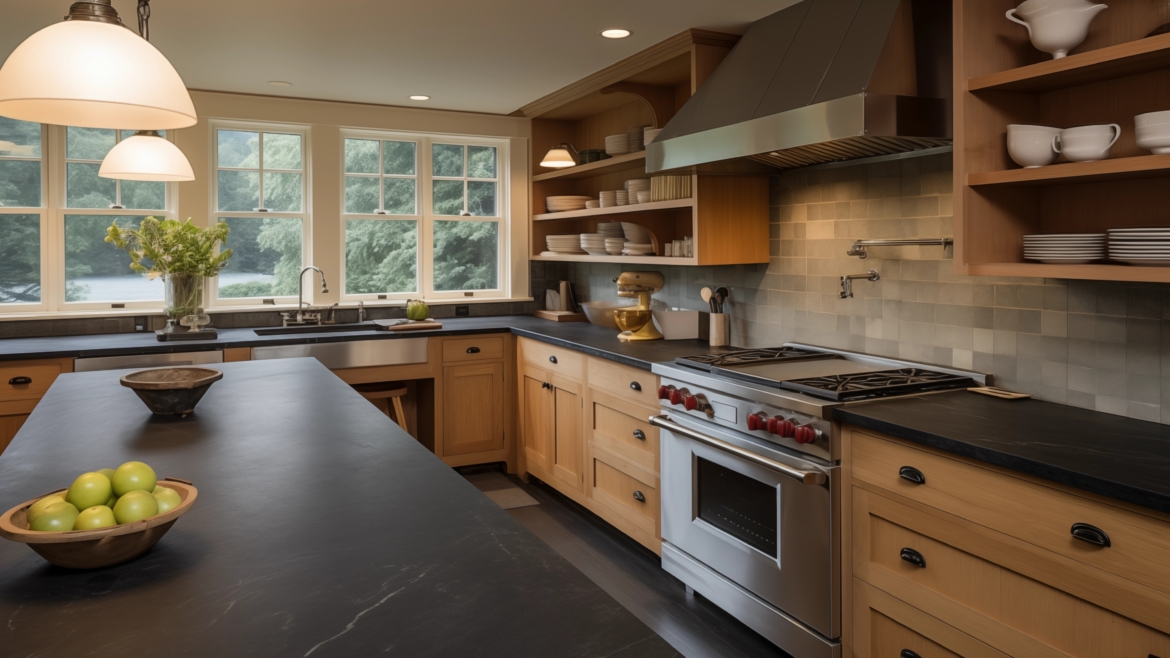
Soapstone countertops have pros and cons that are unlike any other material we fabricate, and the honest version is worth hearing before you commit. This is a stone that never needs sealing, takes a hot pan straight off the burner without flinching, and shrugs off acid completely. It is also soft enough to scratch with a dropped fork.
None of that is a defect. Soapstone asks you to think about a countertop differently. Here is what living with one actually looks like over a few years.
Soapstone Countertops: The Pros and Cons Up Front
On the pro side: no sealing ever, genuine heat resistance, complete immunity to acid, and a surface you can repair yourself at home. That last one is rare. On most countertop materials, damage is permanent.
On the con side: it is soft, it will show scratches and dings, and the color changes over time whether you plan for it or not. The palette is also narrow, running from lighter grays to near charcoal, so if you want a bright white kitchen this is not the material.
The deciding question is not durability. It is whether you want a surface that stays looking new or one that visibly records the life of your kitchen.
What Soapstone Actually Is
Soapstone, technically steatite, is a metamorphic rock made largely of talc along with magnesium silicate and chlorite. That high talc content is responsible for almost everything about how it behaves.
Talc is why the surface has that smooth, faintly soapy feel that gives the stone its name. It is also why the stone is soft, and why it is chemically inert. Soapstone has been used in laboratories for generations precisely because there is nothing you can spill on it that will react with it.
The No-Sealing Part Is Real
Soapstone is naturally non-porous. Not sealed to be non-porous, the way granite and quartzite are. Non-porous on its own, straight out of the ground.
That means no sealing, ever. No water test, no annual routine, no bottle of sealer in the cabinet under the sink. Red wine, coffee, lemon juice and olive oil sit on the surface and wipe off. There is nothing for them to soak into and nothing for acid to react with.
This is the single most misunderstood thing about the material, because people assume that mineral oil is a sealer. It is not, and we will get to what it actually does.
How the Soapstone Patina Develops
Every soapstone counter changes appearance over time. This is not wear in the sense of damage. It is oxidation and handling, and it is the reason people choose the material in the first place.
A new slab reads lighter and matte, often a medium gray. Over months of use, the areas you touch most, around the sink, along the prep run, at the edge where you lean, darken first. Water leaves temporary dark patches that fade as the stone dries. Gradually the whole surface deepens and evens out, and the veining comes forward as the background darkens.
How fast this happens depends entirely on use. A busy kitchen might look noticeably different in six months. A bar top used on weekends could take a couple of years to get there.
The unoiled route
If you leave it alone, the patina develops unevenly at first. Heavy-use areas get there before the corners do. Some people find that stretch awkward and some people find it interesting. Eventually it evens out on its own.
The oiled route
Mineral oil or soapstone wax does one thing: it darkens the stone immediately and evens out the patina so the whole surface looks consistent from day one. It is purely cosmetic. It protects nothing, prevents nothing, and seals nothing.
Oiling is also not permanent. The oil wears off over weeks, the stone lightens again, and you reapply if you want to hold that look. Some homeowners oil monthly for the first year and then taper off. Others do it once, decide they prefer the natural progression, and never do it again.
There is no wrong answer, and it is genuinely reversible in both directions. When we install soapstone we bring an oiled remnant with us so you can see both versions side by side before you decide.
Softness Is the Real Trade-Off
Soapstone is soft. Of everything we fabricate, it is the material most likely to show a mark from ordinary kitchen life. A dropped pan can leave a ding. Sliding a cast iron skillet can leave a line. A ceramic bowl set down hard can leave a scuff.
Here is the part that makes it workable: soapstone marks rather than chips or cracks. The damage is shallow and it sits in a stone that is the same color all the way through. There is no printed layer, no polished skin, no finish to break through.
That is why soapstone is one of the only countertop materials with a real home repair.
How to Sand Out a Scratch
You can do this yourself, and it takes minutes.
- Sand the scratch out with fine sandpaper, working the surrounding area lightly so the repair blends rather than leaving a flat spot
- Wipe the dust away
- If your counter is oiled, re-oil that spot so it matches the rest of the surface
That is the whole procedure. The reason it works is that soapstone has no surface layer to preserve. You are removing a thin amount of stone and exposing identical stone underneath.
To be clear about a claim that circulates constantly: mineral oil does not remove scratches. Oil darkens the surface, which makes a light scratch less visible, but the scratch is still there. Sanding removes it. Oil hides it.
Heat and Chemicals
This is where soapstone quietly outperforms almost everything.
On heat, you can set a hot pot directly on it. Soapstone was used for wood stove surrounds long before it was a countertop material, and there is no resin binder in it to scorch or to crack from thermal shock the way engineered quartz can.
On chemicals, it is inert. Acid does nothing. Where marble etches and dolomite etches, soapstone simply does not react. If you cook with a lot of citrus and vinegar, this is the most forgiving surface in the shop.
What Soapstone Costs in San Diego
Installed pricing runs about $95 to $135 per square foot across San Diego County. Where you land in that range is driven mostly by which slab you pick, since the darker and more dramatically veined stones sit higher.
Fabrication costs are the same as any other material. A sink cutout runs $200 to $340 with faucet holes included. A cooktop cutout runs $150 to $250. Carved edge profiles run $10 to $30 per linear foot. Tearing out your existing counters runs $300 to $800. We charge one rate across San Diego County.
Who Loves Soapstone and Who Regrets It
The people happiest with soapstone wanted a surface with history in it. They like that the counter looks lived in, they are not bothered by a mark, and they find the repair satisfying rather than annoying. Serious cooks tend to land here, because the heat and acid tolerance genuinely make cooking easier.
The people who regret it are the ones who expected a countertop that stays looking new. If the first ding is going to bother you, it will keep bothering you, because there will be more. That is not the material failing. That is the material doing exactly what it does.
We would rather have that conversation before installation than after.
We specialize in granite, marble, quartzite, quartz, porcelain, soapstone and dolomite. If you have something else in mind, ask us and we are happy to talk it through.
How We Fabricate Soapstone
Soapstone cuts more easily than granite or quartzite, which is a shop advantage rather than a customer one. We cut on a CNC bridge saw and a waterjet.
Edge work follows the same standard as every other material we fabricate. Every profile is built up to at least 1 1/2 inches. Our standard is 1 5/8 inches, which is what about eighty percent of our customers choose, and 2 inch and 2 1/4 inch builds are available. We do not charge for the taller miter itself, only for the second layer of plywood underlayment it requires. We fabricate ten edge profiles in-house.
Timing matches our other materials. A typical kitchen runs about seven days from template to install. A bathroom is usually two to three days.
Frequently Asked Questions
Do soapstone countertops need to be sealed?
No, and not ever. Soapstone is naturally non-porous. It does not need sealer when it is installed and it does not need resealing later. This is the one countertop material with no sealing routine at all.
Does mineral oil protect soapstone?
No. Mineral oil is cosmetic. It darkens the stone and evens out the patina so the surface looks consistent, but it does not seal, protect or prevent anything. The stone is already non-porous without it.
Can you remove scratches from soapstone yourself?
Yes. Sand the mark out with fine sandpaper, blending into the area around it, then re-oil that spot if your counter is oiled. Soapstone is the same color all the way through, so there is no finish to damage.
Can you put a hot pan directly on soapstone?
Yes. Soapstone handles direct heat without trouble and contains no resin binder to scorch or crack. It was used for wood stoves long before it was used for countertops.
What are the biggest cons of soapstone countertops?
Softness and a narrow color range. It marks more easily than granite or quartz, and the palette runs from lighter grays to near charcoal with no light or white options. The color also darkens over time, which is a feature if you want it and a drawback if you do not.
Does soapstone stain?
No. Because it is non-porous, liquids sit on the surface rather than soaking in. Wine, coffee, oil and citrus all wipe off without leaving anything behind.
Talk to Us About Your Kitchen
Granite and Marble Concepts is a family-run fabrication and installation shop in El Cajon, serving all of San Diego County. We measure, fabricate and install in-house, so one shop is responsible for your project from template through install day.
Soapstone is a material worth seeing and touching before you decide, more than most. The feel of the surface and the difference between an oiled and unoiled slab do not come across in photographs. Call us at (619) 202-0017 or send us an email and we will set up a free in-home estimate.
If you want to see full slabs, just call or email us with what you are looking for and we will direct you to the partnered showroom that has it in stock.
Leave a reply