
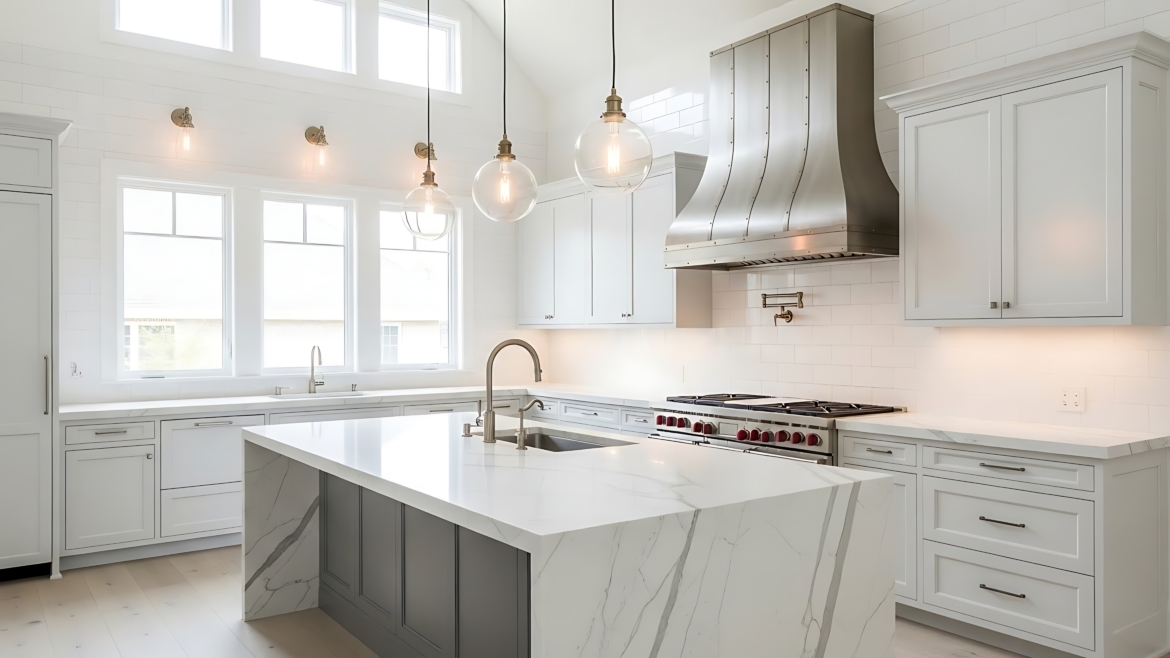
Countertop heat resistance is one of the few material questions with a genuinely clear answer, and it splits the field in an unusual way. Natural stone and porcelain handle a hot pan. Engineered quartz does not.
That is not marketing and it is not close. It comes down to one ingredient, and once you understand what that ingredient does, the rest of this makes sense.
Countertop Heat Resistance: The Short Answer
Granite, quartzite, porcelain and soapstone all take direct heat. You can set a pan down straight off the burner without thinking about it.
Quartz cannot, and it is the only material we fabricate where trivets are genuinely not optional.
Everything else in this article is detail. If you cook seriously and you want to stop thinking about trivets, that first sentence is your answer.
Why Quartz Is the Exception
Quartz is roughly 90 percent or more crushed natural quartz held together with a polymer resin. The mineral part of that mix is not the problem. Ground stone does not care about heat.
The resin does. It is a plastic binder, and heat is what plastic binders are worst at. That same resin is why quartz is non-porous and never needs sealing, so it is not a flaw in the material so much as the trade you accept when you buy it.
What thermal shock actually is
The damage people picture is scorching, a burn mark on the surface. The more common and more serious failure is thermal shock, and it is a different mechanism.
Thermal shock happens when a very hot object meets a much cooler slab. One spot expands fast while the stone around it stays put. That difference creates stress inside the material, and the stress has to resolve somewhere. If it exceeds what the slab can absorb, it cracks.
The crack can appear immediately or show up later. It is not a maintenance issue and it does not buff out.
Where the cracks start
Thermal shock does not strike randomly. It finds the weakest cross section of the slab, which is why the damage shows up in predictable places.
- At a seam, where two pieces meet
- Around a sink or cooktop cutout, where the slab is interrupted
- Along an edge, where there is less material behind the stress
- Anywhere the run is narrow, like the strip between a cooktop and the counter’s edge
The area beside a cooktop is the highest-risk spot in most kitchens, because it combines a cutout, a narrow run, and the exact place people set a hot pan down.
Granite Takes a Hot Pan
Granite formed from cooling magma. There is no resin in it and nothing to scorch. Set a pan on it straight off the burner and nothing happens.
This is one of granite’s genuine advantages over quartz, and it holds regardless of which granite you pick. Color and pattern do not change it.
Granite still needs sealing, and that is a real difference in upkeep between the two materials. But heat is simply not on the list of things you have to manage with granite.
Quartzite Formed Under Heat
Quartzite was made by heat and pressure. It started as sandstone, and the quartz grains fused into a single dense mass under conditions far beyond anything a kitchen can produce.
A hot pan is not an event. Quartzite has the same heat tolerance as granite, with no resin and no binder to worry about.
This is the reason people who want the marble look and cook seriously end up in quartzite. It gives you veining without the heat limits of quartz or the acid sensitivity of marble.
Porcelain Is Fired at Extreme Temperature
Porcelain slabs are manufactured by firing mineral material at very high temperature. Heat is not something the material tolerates, it is how the material was made in the first place.
That makes porcelain excellent on this particular measure. A hot pan is a non-event.
We offer porcelain in 12mm, about half an inch, which has been the standard for years, and 20mm, about three quarters of an inch. We recommend based on your layout, support and design goals rather than on heat, since both handle it.
Heat Resistant Countertops: The Other Three Materials
We fabricate seven materials, and the three not named in this comparison are worth a quick word.
Soapstone is arguably the best of all of them on heat. It was used for wood stove surrounds long before it was a countertop, and it takes direct heat without any concern at all.
Marble and dolomite are natural stone with no resin, so heat is not their weak point either. Their vulnerability is acid. Both are carbonate stones, which means lemon, vinegar and wine will etch them. If you are comparing materials on heat alone you will get a misleading picture of both.
We specialize in granite, marble, quartzite, quartz, porcelain, soapstone and dolomite. If you have something else in mind, ask us and we are happy to talk it through.
What Countertop Heat Resistance Does Not Mean
A few things get overstated in both directions, and it is worth being precise.
Heat resistant does not mean the counter is a trivet. Even on granite or quartzite, sustained heat from something like a slow cooker running for hours is different from a pan set down for two minutes. Direct contact is fine. Parking a heat source there all day is a different question.
Heat resistance also says nothing about scratching, staining, etching or chipping. These are separate properties and a material can be excellent at one and poor at another. Marble handles heat well and still etches from a lemon.
And on quartz, the common phrasing that you can set a hot pan down briefly is worth treating carefully. Some heat exposure will be fine. The problem is that thermal shock does not give you a warning before it happens, and the failure is permanent when it does. That is why we treat trivets as a rule rather than a suggestion.
Can Heat Damage Be Repaired?
This is where the difference between the materials really shows up, because it is not just about whether damage happens. It is about what happens next.
On quartz, a crack or a scorch mark cannot be refinished the way stone can. Usually the affected section has to be replaced, which means a new piece and a new seam.
Natural stone gives you more options, since the material is the same all the way through rather than a mineral and resin composite with a finished surface.
Soapstone is the outlier in the other direction. It is soft, but a mark sands out at home with fine sandpaper because the stone is identical below the surface.
How to Protect Any Countertop
None of this requires much effort, and most of it is habit rather than work.
- Use trivets on quartz, without exception, especially near seams, cutouts and edges
- Keep small appliances that throw sustained heat off the slab, or put something under them
- Avoid setting a hot pan on the narrow strip beside a cooktop, which is the single highest-risk spot in most kitchens
- On natural stone, no special habits are needed for heat, though sealing still matters for stains
The honest summary is that quartz asks for one habit and the rest ask for none.
Countertop Heat Resistance and Choosing Your Material
Countertop heat resistance should not be the only factor in your decision, but it matters more for some households than others.
If you cook seriously, move cast iron around, or run a kitchen where pans land wherever there is space, natural stone or porcelain will make your life easier. That is a real daily difference, not a spec sheet advantage.
If your cooking is lighter and you value never sealing anything, quartz remains a strong choice, and the trivet habit is genuinely manageable once it is a habit. Plenty of our customers live with quartz for decades without a heat problem.
What we would not want is for someone to buy quartz expecting it to behave like granite. The materials are different, and knowing that before installation is worth more than any warranty.
Frequently Asked Questions
Which countertop material has the best heat resistance?
Soapstone, quartzite, granite and porcelain all handle direct heat without trouble, and none of them requires trivets. Soapstone has the longest track record with direct heat, since it was used for wood stoves. Any of the four will take a pan straight off the burner.
Can you put a hot pan on quartz?
We would not. Quartz contains a polymer resin that does not tolerate high heat, and the risk is not just a scorch mark but thermal shock cracking near seams, cutouts and edges. Trivets are not optional on quartz.
What is thermal shock in a countertop?
It is cracking caused by a fast temperature change rather than by heat alone. A hot pan makes one spot expand while the surrounding slab stays cool, and the stress between the two can crack the material. It shows up at the weakest cross section, usually a seam, a cutout or an edge.
Do granite and quartzite need trivets?
Not for heat. Both are natural stone with no resin binder, so a hot pan is not a problem. A trivet does not hurt anything, but it is not protecting the stone from heat damage.
Does countertop heat resistance vary by color or brand?
Not meaningfully on natural stone. Granite and quartzite handle heat regardless of which slab you pick. On engineered quartz, manufacturers describe their heat guidance differently, but the resin binder is common to all of them, so the underlying limitation is the same.
Can a heat crack in quartz be repaired?
Not the way a scratch in stone can be refinished. A crack in quartz usually means replacing the affected section, which introduces a new seam. This is why prevention matters more with quartz than with any other material we fabricate.
Talk to Us About Your Kitchen
Granite and Marble Concepts is a family-run fabrication and installation shop in El Cajon, serving all of San Diego County. We measure, fabricate and install in-house, so one shop is responsible for your project from template through install day.
If heat matters in your kitchen, tell us how you actually cook and we will tell you honestly which materials fit. Call us at (619) 202-0017 or send us an email and we will set up a free in-home estimate.
If you want to see full slabs of a specific material, just call or email us with what you are looking for and we will direct you to the partnered showroom that has it in stock.
Leave a reply