
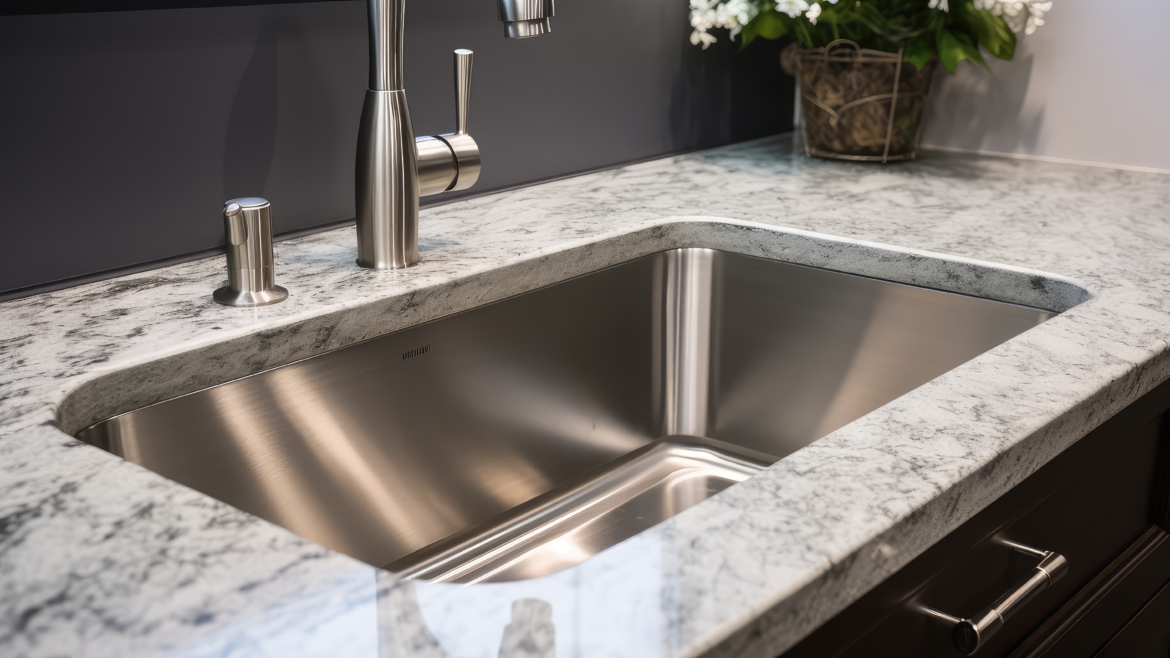
Undermount vs drop-in sinks is a decision most homeowners make on looks alone, and looks turn out to be the part that matters least once you have lived with it. The real differences show up when you are wiping down the counter, when you are trying to fit a sheet pan next to the faucet, and years later when the sink finally gives out and needs replacing.
Here is where we land, and then the reasoning underneath it.
The Short Answer
Between undermount vs drop-in sinks, undermount is almost always the better choice for stone countertops. The counter runs straight into the bowl with nothing sitting on top of it, so you can sweep crumbs and water directly in. Every material we fabricate is rigid enough to carry an undermount sink, so the option is open on all of them.
Drop-in still has real uses, and we install them. It is the right call in specific situations rather than the default one, and we get into those below.
Undermount vs Drop-In Sinks: What Each One Means
Undermount
An undermount sink hangs beneath the countertop. We cut the opening, polish the exposed edge of that opening, and the sink is fastened from below so the stone becomes the visible rim. Nothing sits proud of the surface. When you look down at the counter, you see stone running to the edge of the hole and then the bowl.
This is only possible because stone holds its shape. The countertop is carrying the top edge of the sink, and the cut edge you are looking at is finished stone, which is why the opening has to be polished rather than just cut.
Drop-In
A drop-in sink, sometimes called a top-mount or self-rimming sink, sits in the opening from above and rests on a rim that overlaps the counter. The rim covers the cut edge, so the opening underneath does not need to be polished. You see the sink rim, not the stone, around the bowl.
It is the older approach and it is still perfectly functional. It just puts a raised lip in the middle of your work surface.
The Differences That Actually Show Up
Wiping the counter down
This is the one people notice first and mention most. With an undermount, you push whatever is on the counter straight into the bowl in one motion. With a drop-in, you push it up against a rim and then have to lift it over.
It sounds minor written down. It is something you do several times a day for as long as you own the kitchen.
The rim, and what collects along it
The seam where a drop-in rim meets the stone is caulked, and that caulk line sits in the wettest part of the kitchen. Over time it discolors and eventually needs redoing. An undermount has a joint too, but it sits underneath the stone rather than in the open, and it is not something you are looking at or wiping around every day.
Usable counter space
An undermount gives you back the strip of counter the rim would have occupied. On a tight run between a stove and a window, that can be the difference between a cutting board fitting next to the sink or not.
The look
Undermount shows off the stone. If you paid for a slab with movement in it, an unbroken surface running into the bowl is how you see that movement. A drop-in interrupts it with a band of stainless or composite.
That said, a good drop-in in the right kitchen looks intentional rather than dated. This is a real preference, not a rule.
Fabrication work
An undermount opening takes more work in the shop. The edge is exposed, so it gets polished to the same standard as the outside edge of the counter. A drop-in opening is hidden under the rim, so it does not need that finishing.
How We Cut the Opening
Sink openings are the most stressed cut in a countertop. There is material removed from the middle of the piece, and the corners are where cracks start if the cut is rushed.
We core drill the inside corners first, then cut between them, so the corner ends in a radius rather than a sharp point. A square inside corner concentrates stress and is where a top will eventually split. We also hold a minimum distance between the cutout and any edge, because the narrow strip of stone in front of a sink is the most fragile part of the whole counter.
Our CNC bridge saw and waterjet both handle this. The waterjet can hold a tighter inside radius, which matters most on porcelain.
Reveal: how the sink lines up with the stone
With an undermount you have three choices, and it is worth deciding on purpose rather than letting it happen by default.
- Positive reveal. The opening is cut slightly smaller than the bowl, so a thin band of the sink rim is visible inside the stone edge. Forgiving, and the easiest to keep clean.
- Negative reveal. The opening is cut slightly larger than the bowl, so the stone overhangs the sink edge. Looks seamless from above, but the small ledge of sink underneath the stone catches debris.
- Zero reveal, also called flush. The stone edge and the sink edge line up exactly. It is the cleanest look and it demands the most precision, since any drift is visible all the way around.
Most of our customers end up with a positive reveal. It looks deliberate and it is the least fussy to live with.
What actually holds an undermount sink up
The sink is anchored from beneath with clips or brackets and adhesive, tied into the cabinet structure rather than hanging off the stone by itself. On heavier sinks this matters a great deal. A cast iron or fireclay sink full of water and dishes is a serious load, and that weight needs to be carried by the cabinetry.
We size the support to the sink, not to a general rule. If you have picked something heavy, tell us early and we will plan the bracing before the top is cut.
Undermount Sink Countertop Options, Material by Material
All seven of the materials we fabricate will take either style. A few have specifics worth knowing.
Granite, quartzite and dolomite
Natural stone in three centimeter thickness takes an undermount without any special consideration. The polished cutout edge shows the true color of the stone rather than the surface finish, which is one of the small pleasures of an undermount in granite.
Quartz
Engineered quartz is consistent all the way through, so a polished sink cutout matches the surface exactly. It is about as straightforward as this gets.
Marble
Marble takes an undermount cleanly. The larger question with marble is whether it belongs in a working kitchen at all, since it etches from anything acidic and a sink area sees lemon, wine and vinegar constantly. We generally route marble to vanities and powder rooms where an undermount looks beautiful and lives an easier life.
Soapstone
Soapstone is a favorite here for sink areas. It is naturally non-porous, so it never needs sealing, and standing water does nothing to it. The cut edge takes a clean finish. If the counter around your sink is the part you worry about, this is a material worth looking at.
Porcelain
Porcelain is the one with real requirements rather than preferences, and it is where fabrication experience shows.
- The cutout edge gets a small radius rather than a sharp arris, which protects it from chipping.
- Bracing the undermount sink to the base cabinetry is strongly recommended, not optional.
- Our porcelain jobs run over a plywood subdeck, which supports the material around the opening.
- Cut edges are treated to close the micro fissures that occur naturally when porcelain is cut and polished. This is routine, not a defect.
Farmhouse and other irregular openings are the one place we will steer you away in porcelain, because those cutouts compromise the stability of the panel and need joints in awkward places to compensate.
Farmhouse Sinks Are a Third Category
An apron front or farmhouse sink is not really either of these. The front face of the sink is exposed and the counter meets it on three sides, so the cabinet has to be built to hold it before anything else happens.
The important part is sequencing. The sink needs to be on site and the cabinet built for it before we template, because we are cutting the stone to the actual sink rather than to a specification sheet. Getting this out of order is one of the more common ways a kitchen timeline slips.
Sink Materials, Briefly
Whichever mount you pick, the sink itself is a separate decision. Stainless steel is the workhorse and the most forgiving. Composite and quartz sinks hold color well and are quieter under running water. Fireclay and cast iron look right in a traditional kitchen and are the heavy ones that need the bracing conversation.
We can talk through what pairs well with the stone you have chosen when we come out to measure.
What the Cutout Costs
Our sink cutouts run $200 to $340 depending on the sink and the material. Faucet holes are included with the sink cutout at no extra charge, so you are not paying per hole for a soap dispenser or a filtered water tap.
That figure covers the cutting and finishing of the opening. The sink itself is a separate purchase, and you are welcome to supply your own.
When a Drop-In Sink Countertop Is the Right Call
There are a few situations where we will recommend it without hesitation.
- Rentals and multi-unit properties, where sinks get replaced more often and a drop-in swap does not involve the countertop at all.
- A specific sink you want that is only made as a drop-in, which happens with some vintage and specialty styles.
- A design where the sink is meant to be a visible feature rather than something that disappears.
The practical argument for a drop-in is replacement. When an undermount sink needs changing, the new one has to fit the existing opening and reveal, which narrows your choices. A drop-in just lifts out.
Frequently Asked Questions
Can I put an undermount sink in any countertop material?
In any of the seven we fabricate, yes. Granite, quartzite, dolomite, quartz, marble, soapstone and porcelain are all rigid enough to carry one. Porcelain needs the bracing and subdeck detail described above, which we handle as standard.
Will an undermount sink fall out over time?
Not when it is anchored properly. The failures people have heard about generally trace back to a heavy sink hung off the stone alone without support tied into the cabinet. We size the bracing to the sink, and heavier sinks get more of it.
Is an undermount harder to keep clean underneath?
The joint between the sink and the stone is sealed, so there is nothing open to trap water. A negative reveal leaves a small ledge of sink under the stone that collects debris, which is one reason we usually suggest a positive reveal instead.
Do I need to buy the sink before you come measure?
Yes, and this is the single most useful thing you can do to keep your project on schedule. We cut the opening to your actual sink, not to a catalog dimension, because manufacturing tolerances vary. Have the sink on site at template.
Can I switch from a drop-in to an undermount with my existing countertop?
Almost never worth attempting. The existing opening was cut for a rim to cover it, so the edge is unpolished and usually the wrong size, and polishing a sink cutout in place on an installed top is not something that produces a good result. This is a decision to make with new counters.
How long does the whole project take?
A typical kitchen runs about seven days from template to install. A bathroom is often two or three days depending on the schedule. Larger projects take longer.
What happens with the plumbing on install day?
Our crew disconnects the existing plumbing so the old top can come out. Reconnection is handled separately after the new counters are set, and we will walk you through the timing when we schedule.
Can I see the stone before I commit?
You should. Because we work with a network of partnered showrooms across San Diego County, just call or email us with the material you are looking for and we will direct you to the partnered showroom that has it in stock so you can view the full slab in person.
Ready to Talk Through Your Kitchen?
The sink decision is easier to make in front of the actual slab and your actual layout, and it is one of the things we cover during a free in-home estimate. We will look at your runs, talk through the reveal, and plan the support for whatever sink you have your eye on.
Call us at (619) 202-0017 or email albert@graniteandmarbleconcepts.com and we will get you on the schedule.
Leave a reply