
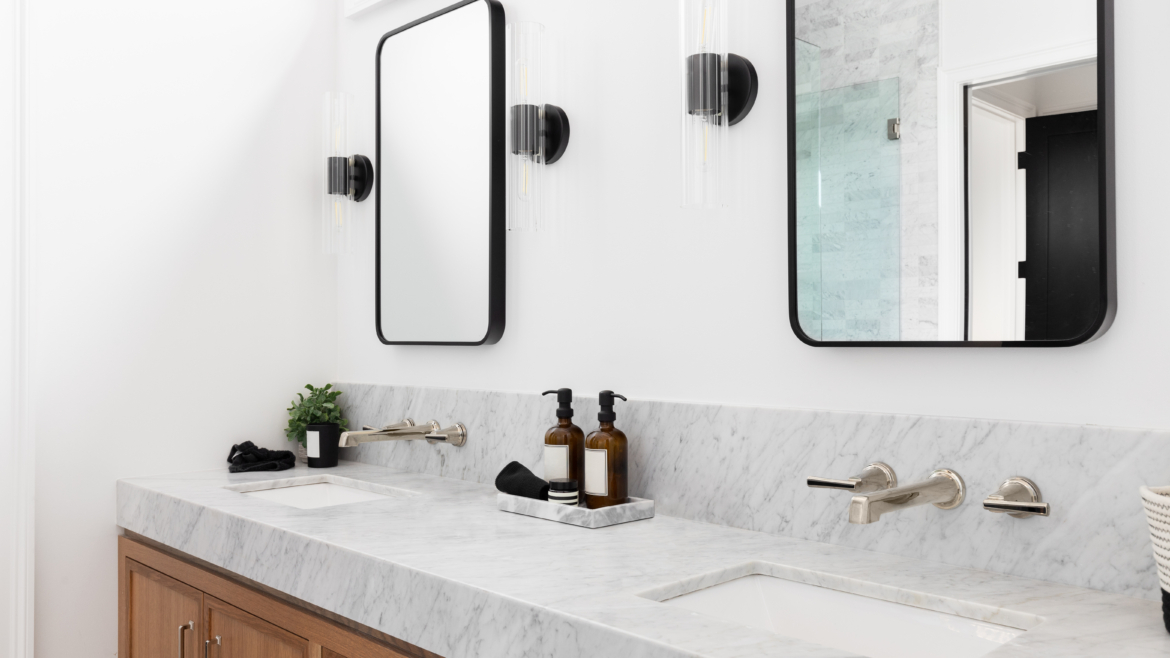
Marble in a busy kitchen is something I get asked about constantly, and I am going to give you the same answer I give in person rather than the one that sells more marble. I do not recommend it. Not because marble is a bad material, but because a kitchen that gets cooked in every day is the hardest possible place to keep it looking the way it looked on install day.
That said, I will fabricate it for you, and plenty of people go ahead. So this covers both halves. Why I steer people away, and exactly what to do if you want it anyway.
Marble in a Busy Kitchen: The Short Answer
Marble etches. Etching is not staining and sealing does not prevent it. In an active kitchen, etching is a matter of when rather than if.
If you love marble and you want it, go in with your eyes open, choose a honed finish, and know that the surface is going to develop a patina. If that idea bothers you, there are materials that give you the look without the worry, and I will cover those at the end.
Why I Steer People Away From Marble in a Busy Kitchen
Etching and staining are two different problems
People use the words interchangeably and they are not the same thing at all.
A stain is something soaking into the stone. Oil, wine, coffee. It goes down into the pore structure and discolors it from within.
An etch is a chemical reaction. Marble is a carbonate stone, and acid reacts with carbonate. When lemon juice or vinegar or wine sits on a polished marble surface, it eats microscopically into the stone and leaves a dull spot where the polish used to be. Nothing has soaked in. The surface itself has changed.
This is the part that surprises people
Sealing helps with staining. Sealing does nothing for etching.
A sealer fills the pores so a spill sits on top long enough for you to wipe it up. That is genuinely useful and it is why we seal. But the acid reaction happens at the surface, above the sealer, on the stone itself. There is no product that prevents it. Anyone telling you otherwise is selling something.
And a kitchen is full of acid
Lemon and lime. Wine. Vinegar and anything dressed with it. Tomato and tomato sauce. Coffee. Orange juice. Some soft drinks. A number of common household cleaners, which is a real problem because people reach for them without thinking.
In a kitchen where somebody genuinely cooks, one of those makes contact with the counter most days. That is the whole issue in one sentence.
Who Actually Does Well With Marble
Here is something I have noticed over the years that you will not read anywhere else.
The customers who go ahead with marble and stay happy with it are almost always people who do not cook much. Their kitchen is beautiful and it gets light use. Coffee in the morning, takeout most nights, real cooking on holidays. For them the marble stays close to how it went in, because the acid contact simply is not happening.
The customers who end up frustrated are the ones who cook every day and expected the surface to stay pristine. The material did not fail them. The expectation did.
So the honest question is not whether you love marble. It is how you actually use your kitchen. Be truthful with yourself about that and the decision usually makes itself.
In practice, most people who ask me about marble for a kitchen end up choosing something else once we have talked it through. Very few move forward. I am not talking anybody out of anything when we have that conversation. I am just laying out what the material does, and most people arrive at the answer on their own.
If You Are Going Ahead, Choose Honed
We offer marble both polished and honed, and if marble is going into a kitchen, honed is the better choice by a wide margin.
A polished finish is reflective, and etching shows up as a dull mark against that shine. The contrast is what makes it obvious. A honed finish is already matte, so an etch has far less to stand out against. The damage still happens. It just does not announce itself.
The same logic applies to scratches. A polished surface is reflective, so anything that breaks up that shine stands out, and that includes scratches and scuffs, not just etching. On a honed surface there is no shine to break, so light surface marks largely disappear into the finish.
Where polished has the edge is staining. Polishing compresses and closes the surface pores, so a spill sits on top a little longer before it starts to absorb. That gives you a slightly bigger window to catch it. Honed does not have that head start, which is why staying current on sealing matters more with a honed top. Honed also shows fingerprints and water spots a bit more readily.
So the trade is straightforward. Polished resists staining marginally better but broadcasts every etch and scratch. Honed hides etching and scratches but asks you to keep the sealer current and wipe spills promptly. In a kitchen, where etching is the damage you cannot undo, that trade favors honed.
For what it is worth, my actual recommendation is honed marble in a low traffic area, like a bathroom vanity or a powder room. That is where marble genuinely shines and where it lives an easy life.
Everything You Can Do to Protect It
If marble is going in your kitchen, these habits are the difference between a surface that ages gracefully and one that frustrates you within a year. I go through all of this with customers at installation.
Daily habits
- Coasters under everything. Not just wine. Citrus drinks, soda, coffee cups, anything with a wet ring.
- Cutting boards always. Never cut directly on the stone, for the counter and for your knives.
- Trivets under hot pans. Marble handles heat reasonably well, but a hot pan set on a cold surface is a risk you do not need to take.
- A tray under the oil bottle, the vinegar, and anything else that lives on the counter and drips.
- Wipe acidic spills immediately. Not in a minute. Immediately. Etching begins on contact.
- Blot rather than wipe. Wiping spreads a spill across more surface area. Blot it up first, then clean the spot.
- Do not let water sit. Standing water leaves marks on marble even without acid involved.
Cleaning
- A pH neutral stone cleaner, and nothing else. This is not fussiness. It is the single most common way people damage marble without realizing.
- Never vinegar. Never lemon. Never bleach or ammonia. Never a generic all purpose spray, because most of them are acidic or alkaline enough to matter.
- Warm water and a soft cloth handles most daily cleanup perfectly well.
- Avoid abrasive pads and powders, which dull the surface mechanically rather than chemically.
Sealing
The first seal is included with your installation and we do it before we leave. After that, sealing is based on how the surface actually gets used rather than a date on the calendar.
The way to check is simple. Leave a small puddle of water on the stone for thirty minutes. If the marble has not darkened when you wipe it up, the seal is still doing its job. If it darkens before thirty minutes, it is time to reseal.
What that usually works out to for marble is every six to twelve months, with a kitchen closer to six and a bathroom vanity able to stretch toward a year. It is a job you can do yourself in an afternoon and we will show you how.
Worth repeating, because it is the thing people most often get wrong. Sealing buys you time against stains. It does nothing against etching.
Making Peace With Patina
The customers who are happiest with marble in a kitchen are the ones who stopped fighting it. Marble has been used in kitchens for centuries, and it has always developed a surface that shows its life. Old European kitchens are full of marble counters covered in soft marks, and nobody considers them ruined.
If you can look at that and see character, marble will make you happy. If you can look at that and see damage, please believe me when I say another material will make you happier.
If You Want the Look Without the Worry
There are two honest alternatives, and we fabricate both.
Quartzite
Genuine quartzite is quartz based, not carbonate, so it does not react to acid and it does not etch. Several quartzites carry the soft white and grey veining people want from marble. It is a natural stone with real depth, it is harder than marble, and it takes sealing.
One caution. Not everything sold as quartzite is quartzite. Some slabs on the market are marble or dolomite wearing a quartzite label, and those will etch exactly like marble does. If you have a slab name and you want to know what you are actually looking at, send it to us and we will tell you.
Quartz
Engineered quartz comes in marble inspired patterns, does not etch, does not stain, and never needs sealing. The trade is that the veining is a manufactured pattern rather than something the earth made, and a discerning eye can usually tell. For a kitchen that gets used hard, it is the lowest maintenance route to a marble look. Note that quartz is an indoor material for most manufacturers.
Frequently Asked Questions
Does sealing marble prevent etching?
No. Sealing helps against staining by slowing absorption, but etching is a chemical reaction between acid and the stone itself, happening at the surface. No sealer prevents it. This is the single most common misunderstanding about marble.
How often should marble be sealed?
Based on use rather than a schedule. Test it by leaving water on the surface for thirty minutes and seeing whether the stone darkens. In practice that tends to work out to every six to twelve months, with kitchens closer to six months and bathroom vanities stretching toward a year.
Can an etch be repaired?
Light etching on a honed surface can often be improved. Deeper etching on a polished surface generally needs professional refinishing of that area, and matching the surrounding polish is difficult. Prevention is genuinely easier than repair here.
Is honed marble better than polished for a kitchen?
Yes, if marble is going in a kitchen. Etching still occurs, but a matte surface gives it far less to contrast against, so it is much less visible. Honed does show fingerprints and water marks a little more, and staying current on sealing matters more.
Will you install marble in my kitchen if I ask for it?
Yes. I will tell you honestly that I do not recommend it, explain exactly why, and then if you still want it we will fabricate it and I will walk you through everything in this article at installation. It is your home and your decision. My job is to make sure it is an informed one.
Where does marble genuinely belong?
Bathroom vanities, powder rooms, fireplace surrounds, and any low traffic surface. In those places marble is beautiful, it is durable enough, and the acid exposure that causes trouble in a kitchen mostly is not there.
Does marble stain easily?
It is porous, so it can stain, particularly with oil. A current sealer plus prompt cleanup handles most of it. Staining is the more manageable of marble’s two issues. Etching is the one that decides whether marble suits you.
How do I see marble in person before deciding?
You should, because photographs do not convey how a slab actually reads in a room. Because we work with a network of partnered showrooms across San Diego County, just call or email us with the material you are looking for and we will direct you to the partnered showroom that has it in stock so you can view the full slab in person.
Let Us Talk It Through
If you are weighing marble against something else, that is a conversation worth having before you fall in love with a slab. During a free in-home estimate we will look at how you actually use your kitchen and give you a straight answer about whether marble fits, including the answer you might not want to hear.
Call us at (619) 202-0017 or email albert@graniteandmarbleconcepts.com and we will find a time.
Leave a reply