
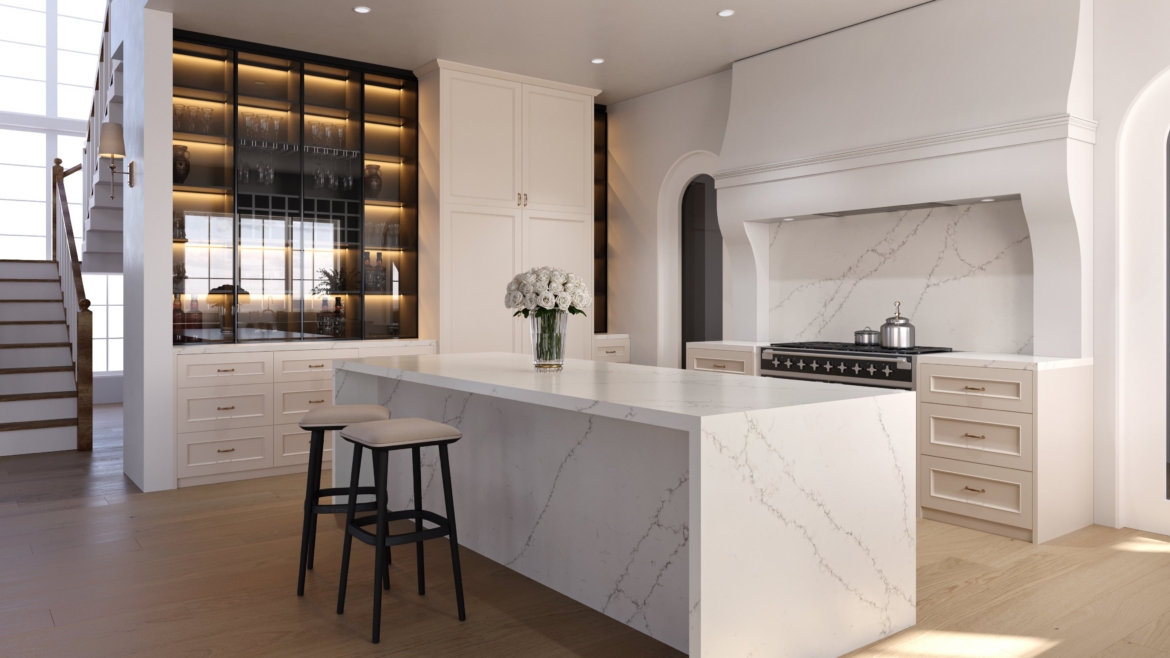
Quartz countertop cost is usually the first question San Diego homeowners ask before they pick a slab, and that’s the right instinct. For a typical kitchen, quartz runs $70 to $130 per square foot installed here in San Diego County, with most kitchens landing between $3,000 and $5,500 total, depending on the tier you choose and how your layout works out.
Let’s break down quartz pricing in San Diego County. Builder-grade slabs start at $70 per square foot, while premium designer options run $110 to $130 or more installed. I’ll show you what drives those numbers up or down, what you should see in a real quote, and how to budget for your specific kitchen. No sales pitch, just the actual numbers you need.
Key Takeaways
- Quartz countertops cost $70 to $130 per square foot installed in San Diego. Most kitchens run $3,000 to $5,500 total.
- Material quality, edge treatments, and custom cutouts are the biggest factors that impact your final price.
- Planning for cabinet leveling, old countertop removal, and plumbing tweaks helps you dodge surprise costs.
Price Tiers Explained
Quartz in San Diego falls into three main price tiers. Knowing them makes budgeting a whole lot easier. Entry-level options start at about $70 per square foot. Mid-range runs $90 to $110, and premium designer slabs reach $110 to $130 or more. Each tier brings a different look and brand cachet, but all are non-porous and tough as nails.
Entry-Level Options
Entry-level or builder-grade quartz is $70 to $90 per square foot installed in San Diego. Think simple, solid colors, subtle patterns, and not much veining. Perfect for rentals, budget remodels, or when you want a clean, understated vibe.
Don’t worry, affordable doesn’t mean flimsy. Entry-level quartz is still non-porous and easy to clean, with no sealing required. You won’t get dramatic marble looks, but you will get a countertop that shrugs off stains and bacteria. Prioritizing function over flash, or staging a home for sale? This tier’s a safe bet. Color choices usually stick to whites, grays, beiges, and basic speckled patterns that play nicely with most cabinets.
Mid-Range Selections
Mid-range quartz costs $90 to $110 per square foot installed. This is where most San Diego homeowners end up. Here, you get realistic marble-look veining and movement, minus the high-maintenance drama of natural stone. Brands like Caesarstone and Silestone are big names in this range.
You’ll see marble-inspired patterns, soft gray veining over white, warm creams with gold, and even concrete vibes. Visual variety skyrockets compared to entry-level. Finishes can be polished, honed, or textured. Most kitchen islands, vanities, and full remodels target this price range. It’s a sweet spot for getting wow-factor without blowing the budget on designer exclusives.
Premium and Designer Choices
Premium and designer quartz is $110 to $130 per square foot installed, sometimes higher. Welcome to the land of Cambria, bold veining, and jumbo slabs with barely-there seams. You’re paying for show-stopping looks and unique designs you won’t find elsewhere.
Jumbo slabs are larger than standard slabs, allowing fabricators to create seamless islands and waterfall edges. Premium quartz mimics the dramatic movement of rare marble. Colors range from deep blacks with gold to crisp whites with thick gray streaks, even blues and greens. If your kitchen’s a showpiece or you’re building a luxury home, this tier is all about visual impact. Cambria, for instance, is made in the USA and comes with a lifetime warranty. It’s more than a countertop; it’s a design statement.
Factors That Affect Quartz Countertop Cost
The slab tier is just the beginning. Other stuff matters too: your kitchen’s size, the edges you pick, how many cutouts you need, and whether you’re demoing old counters. Knowing these details helps you budget and sidestep surprises.
Kitchen Size and Square Footage
Bigger kitchens mean more material and more labor. Most San Diego kitchens clock in at about 40 square feet, which is handy for estimating. Tiny galley kitchens might need 25 to 30 square feet. Sprawling U-shaped kitchens with islands can hit 80 to 100 square feet or more.
Every extra square foot means more cutting, polishing, and measuring. Planning a big island or adding a butler’s pantry? Each additional surface area adds to both material and labor costs. Your fabricator will measure your exact layout before fabrication, so you’ll know what you need.
Slab Thickness: 2cm vs 3cm
2cm and 3cm slabs are both available, and the naming can be a little confusing since 3 sounds bigger than 2. In real terms, 2cm quartz runs about 3/4 inch thick on its own, and 3cm runs about 1 1/4 inch thick. So straight out of the box, 3cm genuinely is the thicker material.
Here’s the twist, though: when we miter a 2cm edge, we fold the material back on itself along the front, building that edge up to a full 2 inches thick, thicker than an unmitered 3cm edge at 1 1/4 inches. That’s why 2cm with a mitered edge is what most San Diego homeowners actually choose, for both standard countertops and waterfall islands. You get an edge that looks and feels more substantial than solid 3cm, since only the edge is built up rather than paying for that thickness across the entire slab.
This is especially popular on waterfall edges, where the mitered 2cm build-up creates that thick, seamless look running down the side of the island, the kind of detail that makes a waterfall feel custom and high-end. 2cm slabs do need a plywood substrate underneath the field for support, which is standard practice, not a shortcut. Once the mitered edge is built up, most people can’t tell the difference between it and solid 3cm just by looking at it or running a hand along the front, if anything, the mitered edge often reads as thicker.
Straight 3cm, without mitering, still has its place, mainly on very large islands or spans where a fabricator wants the thickness consistent throughout rather than built up just at the edge. But for most San Diego kitchens and waterfall islands, 2cm with a mitered edge gets you the thicker, more substantial-looking edge at a better price point.
Edge Profile Options
Our standard edge here at Granite and Marble Concepts is a 2cm mitered edge, built up to a full 2 inches thick and included in your quote. Some other companies default to an eased edge with a stacked build-up instead, gluing a strip flat rather than mitering it at a true 45-degree angle. That leaves a visible seam line where the pieces meet, whereas a properly mitered edge hides the seam so the whole edge reads as one continuous, solid piece of stone.
Eased and beveled are still available as simpler, unbuilt-up edge options if you want a slimmer, more minimal look, and they’re just as clean for modern or transitional kitchens. Waterfall edges are a hot upgrade, running the countertop down the sides of an island, and since we’re already mitering as our standard, waterfalls build naturally off the same technique. Fancy profiles like ogee, bullnose, or Dupont add to the cost depending on how detailed the shaping is, so ask us for pricing on the upgraded edge you like.
Cutouts and Seams
Sinks and cooktop cutouts cost $150 to $400 each, depending on complexity and style. Undermount sinks take more work than drop-ins. Farmhouse sinks? Even more involved, since they show the front edge and need extra finishing.
Cooktop cutouts are similar, especially for induction or gas ranges with special corners. Faucet holes and soap dispensers add a modest amount to the total, and your fabricator will include them in your line-item quote. Seams are placed where they’re least visible, away from sinks and cooktops. Your fabricator will color-match the adhesive so seams nearly vanish, especially on solid or speckled slabs. Dramatic veining takes more planning to match across seams. Most kitchens need at least one seam; bigger layouts might need two or three.
Backsplash and Layout Complexity
Adding a quartz backsplash ups your material and labor costs, but it ties the kitchen together and is a breeze to clean. Full-height backsplashes are trendy but add a lot of square footage. Even a standard 4-inch backsplash adds work, including cutting, polishing, and careful wall attachment.
L-shaped, U-shaped, island, and peninsula layouts mean more cuts, more seams, and more labor. Every corner is another measurement, another cut, another seam. Kitchens with multiple work zones or wraparound counters take longer to template and install, which raises labor costs. Adding a breakfast bar or extending counters? Expect your quote to reflect the extra complexity.
Tear-Out of Old Countertops
Removing old countertops adds about $300 to $800. Laminate is light and easy, so it’s cheaper. Tile, granite, or concrete? Heavier and more work, so higher cost.
Some contractors bundle tear-out into their quotes; others don’t. Ask up front so you’re not hit with a surprise bill. If your old counters are glued or screwed down, removal might mean minor cabinet repairs, which can bump your project cost.
Understanding Your Quote
When you get a quartz quote, you should know exactly what you’re paying for. A clear price covers everything from picking the slab to installation, with no last-minute surprises.
Here’s what should be in your quote:
- The quartz slab material
- Templating your cabinets (down to 1/16 inch accuracy)
- Fabrication with CNC saws and waterjets for clean cuts
- Your chosen edge profile (standard or fancy)
- All sink and cooktop cutouts
- Seam work with color-matched adhesive
- Delivery and installation
- Setting your sink and finishing touches
If a quote looks suspiciously low, some of these steps are probably extra. That’s where those annoying surprise charges sneak in. A clear, line-item quote keeps your budget safe and makes understanding exactly what you’re getting a whole lot easier.
At Granite and Marble Concepts, we’re upfront from day one. Every step, from cutting slabs to polishing edges, gets spelled out in your quote. You shouldn’t have to guess what “installation” covers or worry about extra seam charges.
Quartz never needs sealing, so you can use your new counters the same day. Understand your quote, and you can relax and enjoy your kitchen instead of fretting over hidden fees.
Budget Planning by Kitchen Size
Planning your quartz project in San Diego? Knowing your kitchen’s square footage is key. A typical 40 square foot kitchen costs about $3,000 to $5,500, including materials, fabrication, and installation.
Estimate your project by multiplying your square footage by the price tier you’re considering:
- Entry-level quartz: $70 to $90 per square foot
- Mid-range quartz: $90 to $110 per square foot
- Premium quartz: $110 to $130 per square foot
Smaller 20 square foot jobs run about $1,400 to $2,600 installed, depending on your pick. Bigger kitchens with islands go up from there.
Don’t forget to add $150 to $400 each for sink and cooktop cutouts. Need old countertops removed? That’s usually $300 to $800.
These are ballpark numbers to help you plan. For a real quote, you’ll want a free in-home measure, since your layout, seams, and edge choices all change the total. Your fabricator can check your space and give you an exact price based on what you actually need.
Ways to Save on Quartz Counters
You want quartz, but you don’t want to blow your renovation budget? Here’s how to get the look and durability without the sticker shock. Start with standard colors and simpler patterns. Clean whites, soft grays, and subtle speckles keep costs down. Wild designer veining and jumbo slabs look cool, but they’ll empty your wallet fast.
Your edge profile is one place you don’t have to compromise to save money. Our standard mitered edge, built up to a full 2 inches thick, costs the same as a simple eased or beveled edge, so you get that thicker, more substantial look at no extra charge. Where costs do climb is waterfall panels and fancier profiles like ogee or bullnose, since those take more time and material to shape.
MSI Q Premium Quartz is a solid pick here in San Diego. You’ll find it through our slab yard partner on Miramar Road. Pricing runs around $70 to $90 per square foot installed. Not bad for something that’ll survive your morning coffee spills and dinner parties.
Got a smaller project? Check out remnants and overstock slabs. They’re perfect for vanities, laundry rooms, or that little kitchen island you’ve always wanted, at a fraction of the price. We can also set up package pricing that bundles standard edges and cutouts. You’ll know your number up front, no surprises when the crew shows up.
If you’re thoughtful with your choices, you get more kitchen or bath for your buck, without sacrificing performance or style.
Long-Term Value Assessment
Thinking about quartz for your San Diego kitchen? Wondering if the upfront cost is worth it? Quartz never needs sealing. Granite and marble can’t say the same, so no ongoing maintenance or annual reminders. It’s non-porous, which means wine, coffee, and oil wipe right off. No bacteria hiding in cracks either. Cleanup? Soap and water. That’s it.
Quartz rates about a 7 on the Mohs hardness scale. It handles daily scratches from plates and utensils, though you should still use a cutting board. Color and pattern are consistent from sample to slab, so what you see is what you get, with no weird surprises when your island and perimeter arrive.
But let’s be honest, quartz isn’t invincible. Heat can scorch the resin binder, so always use trivets or hot pads under pots and pans. Light-colored slabs in super sunny kitchens can fade a bit over time. It’s not a dealbreaker, but something to keep in mind if your kitchen bakes in the afternoon sun.
For most San Diego homeowners, durability and near-zero upkeep tip the scales. You’re paying for a surface that works hard and looks good, day after day.
Getting a Local Estimate
A calculator won’t tell you everything. To get real numbers, you need an in-home estimate based on your unique layout and choices. Book a free in-home estimate with Granite and Marble Concepts. We’ll measure your space, count your sink and cooktop cutouts, and walk you through edge and thickness options. That way, you get a firm price, not a ballpark guess.
Because we work with a network of partnered showrooms across San Diego County, call or email us with the material you’re looking for, and we’ll direct you to the showroom that has it in stock so you can view the full slab in person under real light before you decide.
Here’s how to get started:
- Call us at (619) 202-0017 to schedule your free in-home estimate
- Email albert@graniteandmarbleconcepts.com with cabinet drawings, a quick sketch, a few photos, and your questions. We’ll put together a detailed quote.
We serve San Diego County with honest, no-pressure advice. Want to know whether quartz is right for you, or if another material might be a better fit? We’ll walk you through the process, from template to installation.
Frequently Asked Questions
Quartz pricing isn’t one-size-fits-all. It depends on your slab tier, layout, project size, and a few other things. Most folks want to know what the installed price covers, if tear-out is extra, and how quartz stacks up against granite.
What’s the typical price per square foot, and what usually makes it go up or down?
Quartz in San Diego usually runs $70 to $130 per square foot installed. The number moves based on slab tier, edge profile, cutouts, layout, thickness, and whether you need old countertops torn out. Premium veined patterns, waterfall ends, and thicker slabs cost more. Standard colors and simple edges keep it closer to the low end.
When installation is included, what does the per-square-foot total usually look like?
We quote installed pricing ranging from $70 to $130 per square foot. That covers the slab, fabrication, edge profile, cutouts, and installation. No hidden material fees, just one clear total for labor, delivery, and getting your counters ready for use.
Does the price include removing my old countertops?
Tear-out and disposal usually adds $300 to $800, depending on what’s there and how it’s installed. We spell it out as a line item up front. Laminate comes off faster than tile or old stone, so removal costs vary.
How much would a 20-square-foot project usually cost, all-in?
For 20 square feet, expect $1,400 to $2,600 installed, depending on slab tier. That number gets firmed up with a free in-home measure, where we look at edges, cutouts, and layout quirks. Smaller projects sometimes cost more per square foot since setup time is about the same.
If I’m doing a kitchen, what’s a realistic budget range for materials plus install?
A typical 40-square-foot kitchen runs about $3,000 to $5,500 all-in. That’s for a mid-grade slab, our standard mitered edge, a sink cutout, fabrication, delivery, and installation. Premium colors, upgraded edges, or waterfall panels push you toward the high end. Entry-level solid colors keep it closer to $3,000.
Is this material usually cheaper than granite, or am I paying more for the look?
Honestly, it depends. The price ranges for granite and quartz overlap quite a bit. Granite tends to be a little more budget-friendly at the entry level. Quartz can get pricier, especially if you’re eyeing those premium designer styles. Both materials come in entry, mid, and premium tiers, and the final cost really hinges on the specific slab, style, and finish you pick.
Leave a reply