
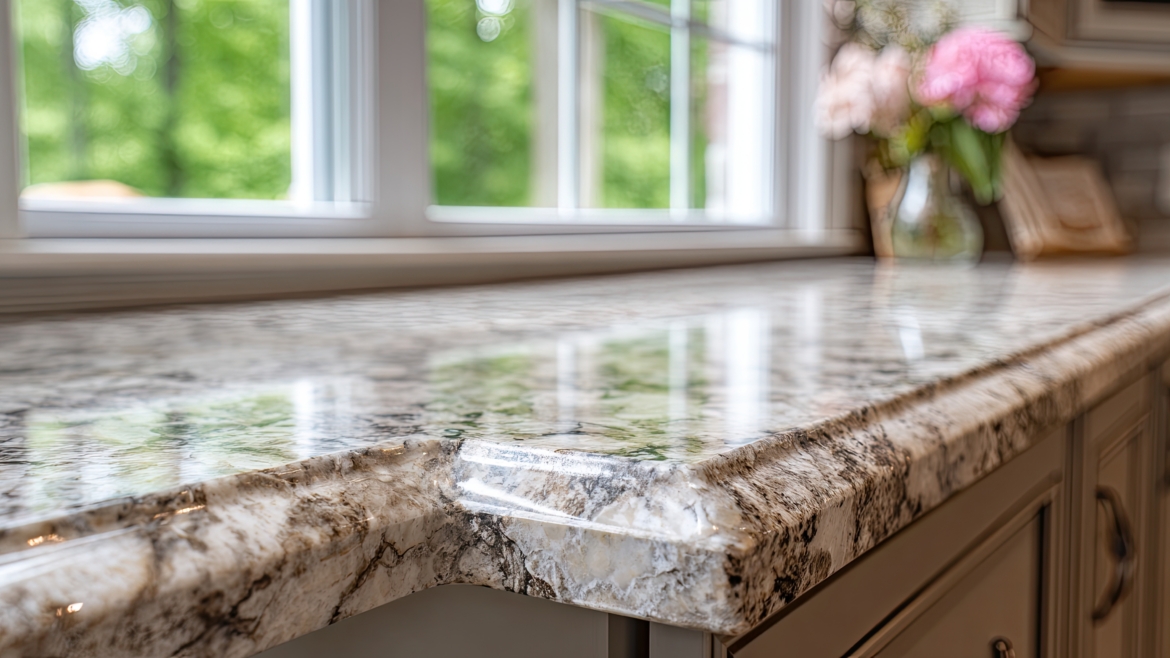
Countertop edge profiles are the last thing most people think about and one of the first things they notice once the stone is in. The edge is what you see at eye level, what your hand runs along, and what decides whether a counter reads as substantial or thin.
The decision is smaller than it looks. Our standard edge is included at no extra charge, most people choose it, and the profiles that do cost more are easy to spot once someone lays them out.
Here is what each of our ten profiles actually is, how a mitered edge gets built, what changes the price, and how to pick one.
Key Takeaways
- Our standard mitered edge finishes at 1 5/8 inches and costs the same as a simple eased or beveled edge. About 80 percent of our customers choose it.
- A mitered edge is two pieces of 2cm stone joined at a 45 degree angle, which hides the seam so the edge reads as one continuous piece.
- We can build the miter to 2 inches or 2 1/4. We do not charge for the taller miter itself, only for the second layer of plywood underlayment it needs.
What an Edge Profile Actually Is
An edge profile is the shape of the exposed front of your countertop, the inch and a half or so you actually see and touch. Everything else about your counter is flat surface. The edge is the only part with a shape to it.
There are two separate things people tend to blend together here. One is the SHAPE, whether the front face is squared, curved, angled, or carved. The other is the HEIGHT, meaning how thick that face looks from across the room.
Deciding those separately makes the choice much easier, and on our profiles the height question is mostly already answered.
Every Profile We Make Is Built Up
This surprises people, so it is worth saying early.
Your slab is 2cm, which is about 3/4 inch. On its own that front face looks thin. So on every profile we fabricate, we join a second piece of the same stone underneath the front edge to build the height up to 1 1/2 inches, or 1 5/8 on our standard miter.
That means choosing between an eased edge and a bullnose is not a choice between thin and thick. Both finish at the same height. What changes is the shape of the face and how the two pieces are joined.
There are two ways to make that joint. Most profiles use a square joint, where the build-up piece meets the top squarely and the shaped profile is cut across both pieces together. The mitered edge uses a 45 degree joint instead, which does something the others cannot. More on that shortly.
The Ten Profiles We Make
We fabricate all ten in house. Grouping them by shape makes the lineup easier to hold in your head.
Squared and Softened
Eased/Square Edge. A squared face with a 1/8 inch radius easing the top corner just enough to feel comfortable. The cleanest look in the lineup and the one that suits contemporary kitchens.
1 1/2 Inch Eased/Square Edge. The same profile, listed by its finished height.
Bevel Square. A squared face with a 1/2 inch angled cut across the top corner. That bevel is substantial enough to catch light along its whole length, which gives the counter a defined line without any curve to it.
Curved
Radius. A 3/8 inch curve on both the top and bottom corners, so the face reads softly rounded while staying mostly square. A gentle option rather than a dramatic one.
Top Radius. A 3/4 inch curve on the top corner only, with the bottom left square. That is a large sweep, and it is the most noticeable single curve we offer short of a full bullnose.
Double Bullnose. Fully rounded top and bottom, so the entire face is one continuous curve. Traditional, soft, and the easiest profile to wipe down since there is nowhere for anything to collect.
Carved
Ogee Square. A carved S curve above a squared bottom, with a 1/8 inch ease at the top. This is the ornate one, and it belongs in traditional and Mediterranean kitchens where the detail has something to answer to.
Ogee Square Out. The same S curve pushed further forward, with 1/8 inch eases at both the top and the step. More pronounced than the standard ogee.
Both ogees are our most expensive profiles. The shaping takes considerably more machine time and hand finishing than anything else on this list, and the price reflects that.
Mitered
Miter Edge. Built at 1 1/2 inches with a 1/8 inch top radius.
1 5/8 Inch Miter Edge. The same construction at 1 5/8 inches. This is our standard and what most of our customers get.
The Mitered Edge, and Why Most People Choose It
How a Mitered Edge Is Built
We cut a strip from the same slab and join it underneath the front of your countertop, with both mating faces cut at a 45 degree angle. The two pieces come together like a picture frame corner.
The edge is hollow behind that miter. That is by design, and it is exactly why the approach works. You get a substantial edge out of 2cm material instead of buying 3cm across the whole kitchen and paying for thickness nobody ever sees.
Why the 45 Degree Cut Matters
We miter at a true 45 degree angle, which hides the seam so the edge reads as one continuous piece of stone. The veining wraps around the corner and the joint disappears into it.
That is the practical difference between the miter and our square-jointed profiles. On a shaped profile like a bullnose or an ogee, the curve itself carries your eye and the joint sits inside the shape. On a plain squared face, a mitered joint is what keeps the front looking like solid stone.
Going Thicker Than 1 5/8
About 80 percent of our customers take the 1 5/8 inch miter and are happy with it. If you want more presence, we can build it to 2 inches or 2 1/4.
Here is the part that matters for your budget. We do not charge for the taller miter. The stone and the labor are the same to us.
What does cost more is plywood. A 2cm countertop needs plywood underlayment beneath the field for support, and our standard 1 5/8 inch edge works with one layer. Building the edge taller means adding a second layer to meet it, which is material we buy and labor we install, so that appears on your estimate.
2 1/4 is the practical ceiling. Larger than that is possible, but a client asks for it maybe once every five years, so it is rare work for us.
What Is Included and What Costs More
Our standard mitered edge at 1 5/8 inches costs the same as a simple eased or beveled edge. It is included in your per square foot price rather than added to it, and there is no version of this where choosing the mitered edge makes your quote go up.
Where cost does climb:
- The ogees. Ogee Square and Ogee Square Out are our premium profiles, and decorative shaping runs about $10 to $30 per linear foot depending on the profile and how much hand finishing it takes.
- A taller miter. Not the miter itself, the second layer of plywood underneath it.
- Waterfall panels. More stone and more work. See below.
Everything else on your edge is already accounted for. Cooktop cutouts run $150 to $250 and sink cutouts run $200 to $340, with faucet holes included at no extra charge, and your estimate lists those separately so you can see them.
Choosing an Edge for Your Kitchen’s Style
Contemporary and modern. Eased/Square or the mitered edge. Clean lines, no ornament, and the mitered build gives you weight without decoration.
Transitional. The 1 5/8 inch miter. It looks intentional in almost any kitchen and dates the least.
Traditional and Mediterranean. Ogee Square or Ogee Square Out, if the budget allows. These profiles want cabinetry with detail on it.
Coastal and casual. Radius, Top Radius, or Double Bullnose. Rounded profiles read softer, and there are no tight corners to catch anything.
Something between. Bevel Square gives you a defined line without a curve, which works when squared feels too plain and carved feels like too much.
One thing worth doing before you decide: look at your cabinet doors. Flat panel doors and a carved ogee tend to argue with each other. The edge does not have to match the cabinets, but it should agree with them.
Choosing an Edge for Your Material
Most profiles work in most stone, but a few pairings are worth knowing.
Quartzite, granite, and porcelain are hard, so carved profiles take longer to shape in them. Porcelain in particular is always mitered, since the material is a finished surface layer over a body and the miter is what carries that finished face around the corner.
Marble and dolomite carve cleanly, which is part of why ogee profiles are so often seen in marble. They are also softer stones, so a rounded profile is a practical choice on a corner that gets bumped.
Soapstone is the softest of the group and finishes by hand beautifully. Simple profiles suit it.
Quartz takes any profile cleanly, and its consistency from slab to slab means the edge looks the same everywhere, which helps if you have several runs meeting up.
Waterfall Panels
A waterfall is the countertop continuing down the side of an island to the floor instead of stopping at the edge.
It is the most dramatic thing you can do with an edge, and it costs more for a plain reason. That vertical panel is more stone, and the corner where the top meets the panel is mitered so the veining runs continuously from the horizontal surface down the vertical one. Getting that match right takes planning at the slab, not just at the saw.
Because mitering is already how we build our standard edge, a waterfall is the same technique at a larger scale. If you are considering one, bring it up early, since it affects how much material your project needs.
How Your Edge Gets Made
After you have chosen your slab, we template your space to about 1/16 inch. Then your stone is cut at our El Cajon shop on our CNC bridge saw and waterjet, using diamond tooling.
The profile is shaped at the machine and then finished by hand. Hand finishing is what takes an edge from technically correct to actually smooth, and it decides how the counter feels when you run your palm along it.
Adhesive is color matched to the stone so the joint reads as shadow rather than as a line.
Most San Diego projects run about 7 days from template to install, and installation day is usually 4 to 8 hours.
Frequently Asked Questions
Does a mitered edge cost more than a standard edge?
No. Our standard mitered edge at 1 5/8 inches costs the same as a simple eased or beveled edge, and it is included in your per square foot price. If you want the miter built to 2 inches or 2 1/4, the miter itself is still no charge. The only added cost is the second layer of plywood underlayment a taller edge needs.
What is the most popular countertop edge?
For us it is the 1 5/8 inch mitered edge, at about 80 percent of jobs. It gives a substantial front face without ornament, works in contemporary and transitional kitchens equally well, and does not date the way heavily carved profiles can.
How thick will my countertop edge be?
Every profile we make is built up to 1 1/2 inches, and our standard miter finishes at 1 5/8. So the shape you choose does not change the height. If you want more than that, we can build the miter to 2 inches or 2 1/4 with the extra plywood layer.
Can you see the seam on a mitered edge?
Rarely, and only if you go looking. The 45 degree cut brings the two pieces together so the stone’s pattern wraps around the corner, and we color match the adhesive to the slab. On a mitered edge the joint disappears into the corner itself.
Which edges cost the most?
Ogee Square and Ogee Square Out. Both take considerably more machine time and hand finishing than the other profiles, and decorative shaping runs about $10 to $30 per linear foot. We will price your specific edge on your estimate rather than leaving you to guess.
Which edge is easiest to keep clean?
Double Bullnose, Radius, and Top Radius, since the curves leave nowhere for anything to collect. The ogees have a recessed curve that will hold crumbs and cleaner residue if you are not paying attention. That is not a reason to avoid one, just worth knowing for a kitchen that gets heavy daily use.
See the Edges in Person Before You Decide
Photographs flatten edge profiles. A shape that looks dramatic on a screen can be subtle in a real kitchen, and the difference between 1 5/8 and 2 inches is something you feel more than you see.
Book a free in-home estimate with Granite and Marble Concepts. We will measure your space, count your cutouts, and talk through edges against your actual cabinets and lighting, which is where the decision really gets made. You will get an itemized estimate showing exactly what your edge choice does and does not add.
Two easy ways to get started:
- Call us at (619) 202-0017 to schedule your free in-home estimate.
- Email albert@graniteandmarbleconcepts.com if you would rather skip the visit. Send cabinet drawings if you have them, or just a rough sketch of your existing counters with a few photos and any questions you have. That is plenty for us to work from.
We fabricate every edge in house at our El Cajon shop, and we serve San Diego County with straight answers and no pressure.
Leave a reply