
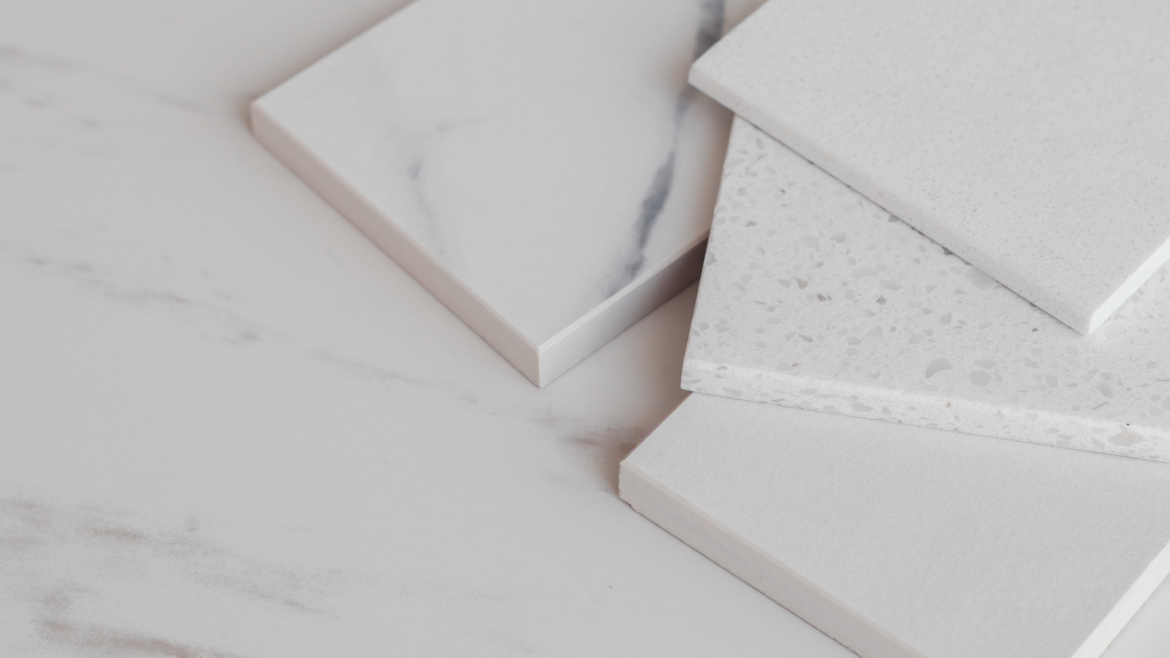
How quartz is made explains almost everything about how it behaves in your kitchen: why it never needs sealing, why it shrugs off wine and lemon juice, and why a hot pan straight off the stove can genuinely damage it.
Quartz is a man-made countertop built mostly from real quartz crystals. The quartz gives it strength and hardness, while a resin binder holds everything together and creates a smooth, non-porous surface. That one sentence is the whole material. Everything quartz does well, and the one thing it does badly, comes back to those two ingredients.
We fabricate and install quartz across San Diego County, and it is the most popular material we work with. Here is how it is actually made, and what that means for the counter you live with.
Key Takeaways
- Quartz is engineered from real quartz crystals bound in resin, which is why it is non-porous and never needs sealing.
- The resin is also the weak point. Concentrated heat can scorch or discolor it, and sudden temperature change can crack the slab, so trivets are not optional.
- Because the pattern is manufactured, quartz is consistent from slab to slab, which makes big kitchens easier to plan than any natural stone.
How Quartz Is Made, Step by Step
Understanding the process takes about two minutes, and it is worth those two minutes because every care instruction you will ever hear about quartz traces back to it.
It starts with real stone
Quartz is one of the most abundant minerals on earth, and it is genuinely hard, a 7 on the Mohs scale, harder than granite. Manufacturers start with natural quartz that has been crushed into fine aggregate.
The proportion matters. Quality engineered quartz is roughly 90 percent or more ground natural quartz by weight. That high stone content is where the hardness and scratch resistance come from. It is real stone, just not a slab of it.
The resin binds it
The crushed quartz on its own is a pile of sand. What turns it into a countertop is a polymer resin binder, mixed through the aggregate along with pigments for color and pattern.
The resin does three jobs. It glues the crystals into a solid slab. It fills every microscopic gap, which is what makes the surface non-porous. And it carries the color, from pure whites to the marble-look veining that has made quartz so popular.
Pressed, cured and polished
The mixture is poured into a mold and compacted under enormous pressure and vibration, usually under vacuum, which squeezes out the air and packs the material dense. The slab is then cured with heat, which hardens the resin permanently, and finally ground and polished to its finished surface.
The result is a slab that is dense, uniform and sealed by its own construction. Nothing about it is porous, so there is nothing for a sealer to do. That is not a marketing claim, it is a consequence of how the material is built.
The pattern is designed, not found
With natural stone, the pattern is whatever the earth made. With quartz, the pattern is designed. Pigments and veining are placed during manufacturing, which is why a quartz color looks essentially the same from slab to slab.
That consistency is a genuine advantage on a big job. A kitchen that needs three slabs of natural stone means matching three unique pieces. Three slabs of the same quartz color simply match. It also means what you see in a sample is very close to what arrives, which is not something any natural stone can promise.
What the Manufacturing Explains
Here is where the two minutes pay off. Each of quartz’s famous traits is a direct result of an ingredient.
Never needs sealing: the resin
Natural stone is porous, so it absorbs liquid and needs a sealer to slow that down. Quartz has its pores filled with resin at the factory. There is nothing to soak into, so there is nothing to seal, not at installation and not ever.
Granite wants sealer every 6 to 12 months in a busy kitchen. Quartzite runs about once a year. Quartz is soap and water for the life of the counter, and that difference is the resin.
Resists stains and acid: the resin again
Wine, coffee, lemon juice and tomato sauce sit on the surface of quartz instead of soaking in, so they wipe up whenever you get to them. And because the surface is not calcium carbonate, acid does not etch it the way it etches marble and dolomite. No dull spots from a squeezed lemon.
Hard and scratch-resistant: the quartz
The 90-plus percent stone content is why quartz resists everyday scratching well. You should still use a cutting board, both for your knives and because deep damage in quartz is not repairable the way it is in some natural stone. But normal kitchen life does not mark it.
The Trade-Off: Heat and the Resin
Everything above is the resin working for you. Heat is where it works against you, and this is the part we explain at every quartz estimate.
Why a hot pan is a real risk
The quartz mineral itself handles heat fine. The resin does not. Concentrated heat from a pan straight off the stove or a baking sheet out of the oven can discolor, scorch or stress the resin at the surface. That damage is permanent, and it tends to happen in exactly the spot you use most.
This is not a defect. It is the material being what it is. The same ingredient that gives you a sealed, non-porous, stain-resistant surface has a temperature limit that natural stone does not.
Thermal shock, and where quartz cracks
There is a second heat risk beyond scorching, and it is the one people do not see coming. Quartz can suffer thermal shock: a very hot pan set directly on a cooler countertop causes a rapid temperature change in one small area, and the stress from that change can crack the material.
Those cracks show up where the slab is already working hardest, near seams, around sink and cooktop cutouts, along edges, and in thinner areas. A crack like that is not a surface mark you can polish out. It is structural, and the repair conversation is usually a replacement conversation.
The fix costs five dollars and sits in a drawer. Use a trivet or a hot pad for anything coming off the stove or out of the oven, every time. That single habit removes the one real vulnerability the material has.
Sunlight is the same story
UV affects resin too, which is why quartz is an indoor material for most manufacturers. Direct sun over time can yellow or fade the surface. Caesarstone offers a small number of colors rated for outdoor use, but as a rule, quartz stays inside. For an outdoor kitchen, porcelain, quartzite and granite are the three that work, and we fabricate all of them.
Quartz Against the Natural Stones
Knowing how each material is built makes the comparison simple.
Quartz: engineered, non-porous, never sealed, does not etch. Needs trivets, stays indoors. $70 to $130 per square foot installed.
Granite: natural, takes direct heat without a thought, works outdoors. Wants sealer every 6 to 12 months in a busy kitchen and every 1 to 2 years in low use areas. $75 to $125 and up.
Quartzite: natural, harder than granite, takes heat, works outdoors, and carries the marble look in real stone. Seals about once a year for typical kitchen use. $80 to $200 and up.
Marble: natural, beautiful, and acid etches it, which no sealer prevents. We steer people away from it in an active kitchen and toward a vanity or powder room where it stays pristine. $75 to $250 and up.
The pattern is consistent. Natural stone trades maintenance for heat tolerance and outdoor use. Quartz trades heat tolerance for zero maintenance. Neither is better. They are built differently, and the right one depends on how you cook and where the counter goes.
Is Quartz Right for Your Kitchen?
Quartz makes sense for most busy indoor kitchens, which is why it is the most popular material we install. If you want a surface you never think about beyond a wipe-down, and you can live with the trivet habit, it is hard to argue against.
It is the right call when consistency matters, on large kitchens with multiple slabs, and when the maintenance answer needs to be zero, in rentals, second homes, or any household where sealing schedules are never going to happen.
It is the wrong call for an outdoor kitchen, and it is the wrong call if you routinely move pans from burner to counter without thinking. Granite or quartzite suits that cook better, and we will tell you so at the estimate.
If you are torn between quartz and a natural stone, tell us how you actually cook. That answer usually settles it in about a minute.
Frequently Asked Questions
What is quartz countertop material actually made of?
Roughly 90 percent or more crushed natural quartz crystals, bound together with a polymer resin and pigments. The quartz provides the hardness and scratch resistance, and the resin binds the crystals into a solid slab, fills every pore, and carries the color and pattern. It is engineered stone: real quartz mineral, man-made slab.
Why does quartz never need sealing?
Because the resin already did the sealer’s job at the factory. Sealers exist to slow liquid absorption into porous stone. Quartz has its pores filled with resin during manufacturing, so there is nothing for liquid to soak into and nothing for a sealer to do. Soap and water is the entire care routine, for the life of the counter.
Can I put a hot pan on quartz?
No, and this is the one rule that matters with quartz. The quartz mineral handles heat, but the resin binder does not. A pan straight off the stove can scorch or discolor the surface permanently, and the rapid temperature change can cause thermal shock, cracking the slab near seams, cutouts, edges or thinner areas. Use a trivet or hot pad every time. It is the whole cost of owning the material.
What is thermal shock in a quartz countertop?
Thermal shock is what happens when a very hot pan or baking sheet lands on a cooler quartz surface. One small area heats and expands rapidly while the surrounding slab does not, and the stress from that difference can crack the material. The cracks tend to start where the slab is already under load, near seams, around sink and cooktop cutouts, along edges and in thinner spans. That kind of crack is structural rather than cosmetic, which is why the trivet habit is worth taking seriously.
Does quartz etch or stain like marble?
No. Etching happens when acid reacts with the calcium carbonate in stones like marble and dolomite, and quartz contains neither, so lemon juice, vinegar and wine do not dull it. Staining requires liquid to soak in, and the resin-filled surface does not absorb, so spills sit on top until you wipe them. That combination is exactly why quartz is the default recommendation for busy indoor kitchens.
Can quartz countertops go outside?
For most manufacturers, no. UV exposure degrades the resin over time, yellowing or fading the surface, so quartz is an indoor material, with Caesarstone offering a small number of colors rated for outdoor use. For an outdoor kitchen the three that work are porcelain, quartzite and granite. Porcelain is the easiest of them outside, since it needs no sealing routine at all out there.
Get a Quartz Estimate in San Diego
If quartz sounds like your material, the next step is seeing real slabs and getting real numbers on your actual kitchen.
Because we work with a network of partnered showrooms across San Diego County, call or email us with the colors you are considering and we will direct you to the partnered showroom that has them in stock. And because quartz is consistent slab to slab, what you see there is very close to what gets installed.
Two ways to start:
- Call us at (619) 202-0017 to schedule your free in-home estimate.
- Email albert@graniteandmarbleconcepts.com with your cabinet drawings, or just a sketch and a few photos, and we will put together a detailed quote.
Have a material in mind that is not on our list? Just ask. We are happy to talk through your options.
We fabricate and install quartz, granite, quartzite, marble, porcelain, soapstone and dolomite throughout San Diego County from our shop in El Cajon. If quartz is not the right fit for how you cook, we will tell you that too.
Leave a reply