
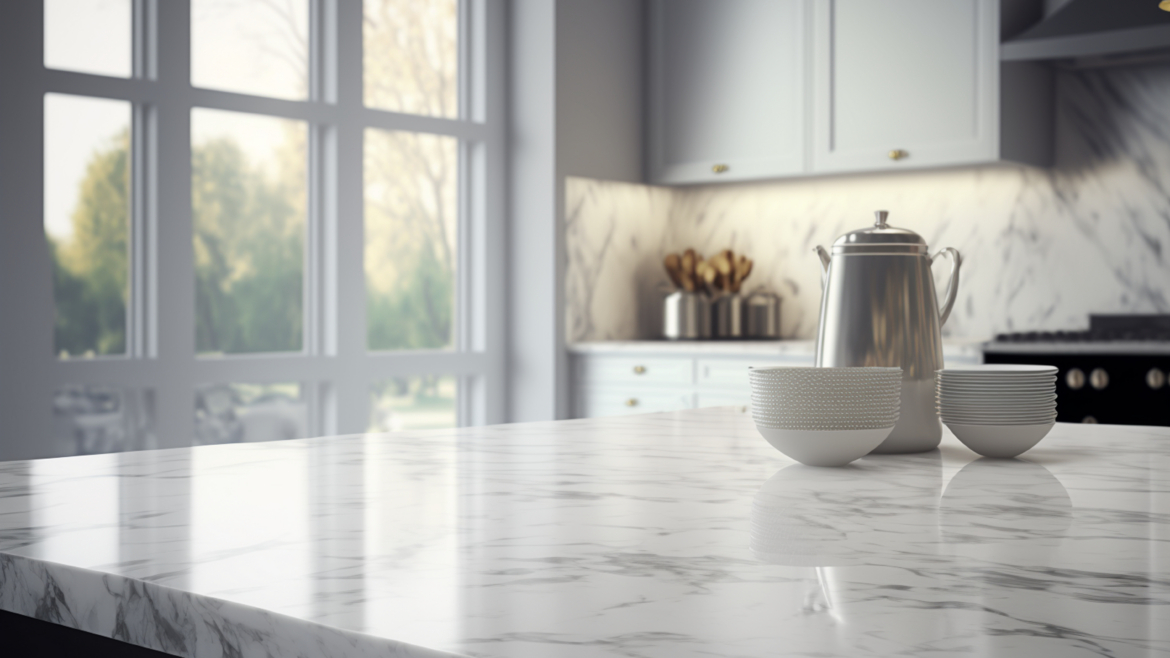
Marble etching is the thing nobody tells you about until it happens. A lemon gets squeezed, somebody wipes it up an hour later, and there is a dull spot in the polish that will not come out with cleaner.
Here is the part that surprises people most: sealing does not prevent it. A sealer improves stain resistance, and that is worth having, but it does nothing about etching. Those are two different problems and only one of them has a product that fixes it.
We fabricate and install marble, and we will build you a beautiful marble kitchen if that is what you want. But we do not recommend marble for an active kitchen, and we would rather tell you why before you buy than after. Here is the honest version.
Key Takeaways
- Etching is not a stain. It is acid removing the polish from the surface, and no sealer prevents it.
- We do not recommend marble for an active kitchen. It is a maintenance-and-patina material, not a worry-free countertop.
- Marble’s best use is a low-traffic area like a bathroom vanity, where it sees almost no acid and no heat.
What Marble Etching Actually Is
Marble is calcium carbonate. Acid reacts with calcium carbonate. That reaction eats away the polished surface of the stone, and what is left is a dull, slightly rough patch where the shine used to be.
That is etching. It is physical damage to the surface, not something sitting on top of it.
The distinction matters because it decides what can be done about it. A stain is a substance that soaked into the stone, and you can often draw it back out. An etch is stone that is no longer there. There is nothing to draw out.
The things that cause it are ordinary kitchen items:
- Lemon, lime and any citrus
- Vinegar and vinaigrette dressings
- Wine
- Tomato and tomato-based sauces
- Acidic cleaners, including many products sold as all-purpose
It does not take long. On polished marble a splash of lemon juice can leave a mark in the time it takes to finish what you were doing and come back.
The Truth About Sealing
This is the single biggest misunderstanding about marble, and plenty of the material written about it does not clear it up.
An impregnating sealer soaks into the pores of the stone and slows down absorption. That means a spill sits on the surface longer before it works its way in, which gives you time to wipe it up before it becomes a stain. That is genuinely useful and marble is porous, so it is worth doing.
What sealer does not do is protect the surface from a chemical reaction. Acid still reaches the calcium carbonate. The stone still reacts. You still get an etch.
So a properly sealed marble counter resists staining well and etches exactly as readily as an unsealed one.
If somebody tells you a sealer will stop marble from etching, that is not correct, and it is the kind of thing a homeowner finds out the hard way six months after installation.
What sealing marble actually looks like
Marble wants sealing every 6 to 12 months, closer to 6 in a kitchen and toward a year on a vanity.
Rather than working from a calendar, run the water test. Put a small puddle of water on the counter. If the stone darkens in the first few minutes, the sealer is thin. For a reliable read, leave the puddle sitting for 30 minutes. No darkening at that point means the sealer is still doing its job.
We apply the first seal at installation. After that a bottle runs about $20 if you do it yourself, or $100 to $200 to have it done.
Why We Do Not Recommend Marble for an Active Kitchen
We will say this plainly, because it costs us work to say it and it is still the right advice.
Marble is acid-sensitive and porous. In a kitchen where somebody cooks most nights, that combination means you are going to get etching, and you are going to get it in the places you look at most: around the sink, next to the cooktop, on the island where people set glasses down.
It is not that the stone fails. Marble has been in kitchens for centuries and it will outlast the cabinets under it. The problem is the gap between what people expect and what they get.
Most homeowners choosing marble picture it looking on year five the way it looked on install day. That is not what happens. What happens is a surface that accumulates marks, and you either come to like that or you spend years being irritated by it.
That is a real decision, and it should be made before the slab is cut rather than discovered afterward.
What we mean by a maintenance-and-patina material
Marble asks two things of you. Keep the sealer current, and accept that the surface will change.
Some people genuinely want that. There is a whole tradition of marble kitchen counters in Europe that are covered in etch marks and considered better for it, the same way a wooden cutting board or a cast iron pan earns its character. If that is how you see it, marble is a wonderful choice and you will be happy with it.
If you want a counter that looks new indefinitely, marble is the wrong material and no amount of care changes that.
If You Want Marble Anyway: Polished or Honed
Plenty of people hear all of the above and want marble regardless. That is a legitimate choice and we will build it for you. The finish you pick changes what you live with.
Polished
Polished marble has the reflective, glassy surface most people picture. It is the better finish for stain resistance, because the tighter polished surface gives liquid less to work with.
The trade-off is that etching shows dramatically. An etch mark on polished marble is a dull spot against a mirror, and it catches the light from across the room.
Honed
Honed marble is matte. It starts with no shine to lose, which means etching is far less visible. An acid mark on honed marble is a subtle change in texture rather than an obvious dull patch, and it hides scratches better too.
The trade-off runs the other way: a honed surface is more open than a polished one, so it is a little less resistant to staining and wants the sealer kept current.
How to choose between them
It comes down to which problem bothers you more.
If you are worried about stains, polished is the better finish. If you are worried about etching and scratches showing, honed is the better finish.
For a kitchen specifically, most people who go ahead with marble are happier with honed, because etching is the thing they will actually encounter and honed is the finish that hides it. But it is your call and both are defensible.
Where Marble Genuinely Works
None of this means avoid marble. It means put it where it makes sense.
Marble’s best use is a low-traffic area, and a bathroom vanity is close to ideal. A vanity sees almost no acid, no hot pans, no cutting, and no cooking. The things that damage marble in a kitchen simply are not present.
You get the full beauty of the material in a room where it can stay beautiful, and you pay for a much smaller piece of stone than a kitchen would need.
Other places it works well:
- Powder rooms and guest baths, which see even less use than a primary vanity
- A dedicated baking station, where marble’s cool surface is a genuine advantage for pastry work
- Fireplace surrounds, which we fabricate, where the stone is decorative and nothing acidic goes near it
- A furniture piece or a shelf, where it is looked at rather than worked on
In every one of those, marble does what it does best without being asked to be something it is not.
What We Suggest for a Working Kitchen
If you love the marble look and you cook, there are two natural stones that get you close without the same trade-off.
Quartzite
Quartzite is silicate rather than carbonate, which is the whole point. It does not react with acid the way marble does, so etching is not the concern it is with marble. It rates a 7 on the Mohs scale, harder than granite, and it takes a hot pan straight off the burner.
Many quartzites read very close to marble, with real veining and a crystalline depth engineered surfaces do not reproduce. It seals about once a year for typical kitchen use, and it works outdoors as well as in.
Installed it runs $80 to $200 and up, against marble at $75 to $250 and up, so the ranges overlap.
Dolomite
Dolomite sits between the two. It is harder than marble and more acid-resistant, so you get meaningful time to wipe up a spill rather than reacting immediately. It still etches, so it is not immune, but the difference in a working kitchen is real.
It runs $85 to $125 installed and follows the same use-based sealing pattern as quartzite. Worth knowing: a lot of stone sold as quartzite is actually dolomite, so it pays to confirm what you are buying.
Quartz
If what you want is the marble look with no maintenance at all, engineered quartz is the honest answer. It is non-porous, never needs sealing, and does not etch. Modern marble-look quartz is convincing enough that most guests will not know.
The trade-offs are heat and sunlight. The resin can scorch above roughly 300 degrees, so trivets are not optional, and for most manufacturers quartz stays indoors, with Caesarstone offering a small number of colors rated for outdoor use.
It runs $70 to $130 installed, which is the lowest entry point of the four.
Frequently Asked Questions
Does sealing marble prevent etching?
No. A sealer improves stain resistance by slowing absorption into the stone, which is worth having, but it does nothing about etching. Etching is acid reacting with the calcium carbonate on the surface, and sealer does not stand between them. A properly sealed marble counter resists staining well and etches exactly as readily as an unsealed one.
Is marble a bad choice for a kitchen?
We do not recommend it for an active kitchen, and we will say so on an estimate. Marble is acid-sensitive and porous, so in a kitchen that gets real use you will get etching in the places you look at most. It is a maintenance-and-patina material rather than a worry-free countertop. If you love it and you accept that the surface will change, marble is a fine choice. If you expect it to look new in five years, it is the wrong material.
Should I choose polished or honed marble?
It depends which problem bothers you more. Polished is the better finish for stain resistance, but etching shows dramatically against the shine. Honed is matte, so it hides etching and scratches far better, at the cost of being slightly more open to staining. For a kitchen, most people who go ahead with marble are happier with honed, since etching is what they will actually encounter.
Can marble etching be repaired?
Light etching can often be improved with a marble polishing powder. Deeper etching needs professional honing and repolishing to restore the finish, which is why prevention matters more with this stone than with any other we work with. On a honed surface the whole question is less pressing, since there is no polish to lose.
Where is marble actually a good idea?
Low-traffic areas, and a bathroom vanity is close to ideal. A vanity sees no acid, no heat and no cutting, so the things that damage marble in a kitchen are simply absent. Powder rooms, a dedicated baking station and fireplace surrounds all work well too. You get the full beauty of the stone in a place where it stays beautiful.
What should I use instead if I want the marble look in a kitchen?
Quartzite is the closest natural stone. It is silicate rather than carbonate, so it does not react with acid the way marble does, it is harder than granite, and it takes direct heat. Dolomite is a middle ground that still etches but gives you more time. If you want zero maintenance, marble-look quartz never needs sealing and does not etch, though it needs trivets and stays indoors.
Talk It Through Before You Buy
The worst version of this decision is the one made from a photo. Marble in a showroom under bright light is a different thing from marble in your kitchen after two years of dinners.
Bring us the room and we will tell you honestly whether marble suits it. If it does, we will build it and walk you through the care. If it does not, we will show you what gets you the same look without the same trade-off, and price both so you are choosing between real numbers.
Because we work with a network of partnered showrooms across San Diego County, call or email us with the materials you are considering and we will direct you to the partnered showroom that has them in stock, so you can see full slabs side by side.
Two ways to start:
- Call us at (619) 202-0017 to schedule your free in-home estimate.
- Email albert@graniteandmarbleconcepts.com with your cabinet drawings, or just a sketch and a few photos, and we will put together a detailed quote.
Have a material in mind that is not on our list? Just ask. We are happy to talk through your options.
We fabricate and install throughout San Diego County from our shop in El Cajon. If a material is wrong for your kitchen, we will tell you that too.
Leave a reply