
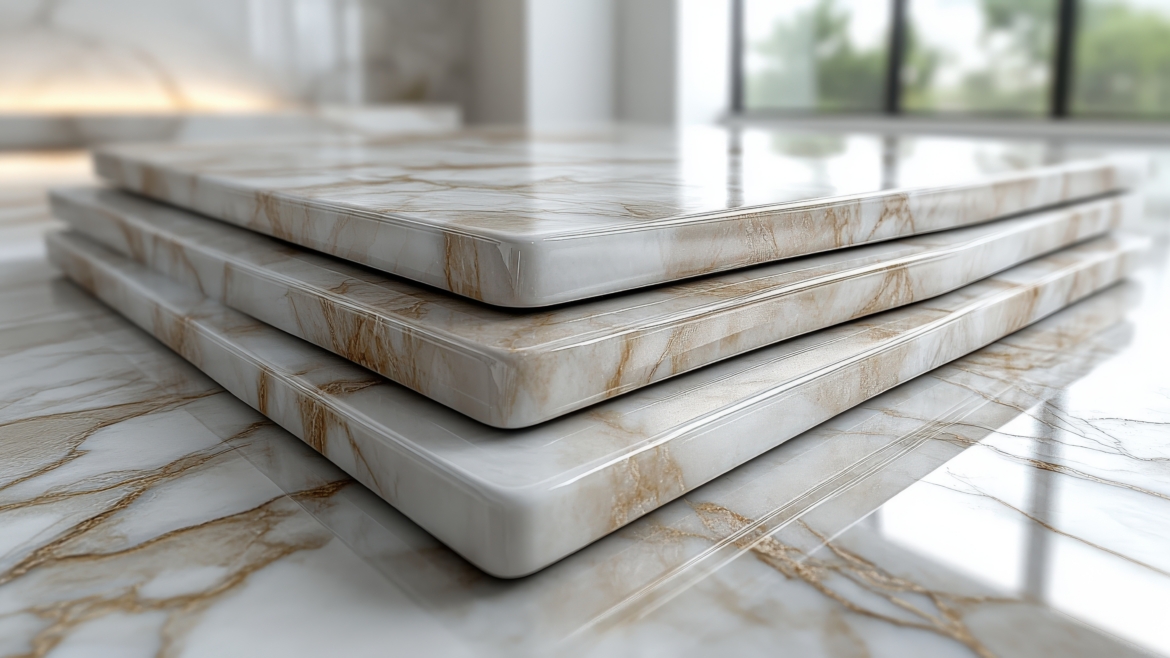
Porcelain countertop cost in San Diego runs about $80 to $250 or more per square foot installed, which puts it alongside high-end quartz and quartzite rather than below them. Porcelain is a premium material, and the price reflects both what the slabs cost and what it takes to fabricate them properly.
The range is wide because porcelain is priced by brand and design tier, the way quartz is, rather than by rarity the way natural stone is. A mid-range Italian slab and an ultra-premium book-matched Calacatta look sit at opposite ends of that spread, and both are porcelain.
So here is the full breakdown: what each tier costs and what it gets you, why porcelain fabrication is priced the way it is, what a complete installed number includes, and how to budget for a kitchen, an island, or the outdoor project porcelain is so often bought for.
Key Takeaways
- Porcelain runs $80 to $250 and up per square foot installed in San Diego, with the brand tier and design driving most of the difference.
- Mid-range porcelain sits at $80 to $110, premium at $110 to $160, and ultra-premium sintered stone at $160 to $250 and up.
- Porcelain never needs sealing, indoors or out, so the installed price is close to the whole cost of owning it.
Porcelain Countertop Cost by Tier
Porcelain is priced by brand and design complexity, and the market sorts into three tiers. These are installed numbers, not slab prices.
| Tier | Brands | Installed, per square foot |
| Mid-range | Florim, Atlas Plan, Inalco | $80 to $110 |
| Premium | Laminam, Lapitec | $110 to $160 |
| Ultra-premium | Neolith, exotic Calacatta looks | $160 to $250 and up |
For a typical 40 to 50 square foot San Diego kitchen, that works out to roughly $3,200 to $5,500 at mid-range, $4,400 to $8,000 at premium, and $6,400 to $12,500 or more at the top.
Worth knowing before you assume the top tier is the better product: every tier is the same material doing the same job. All of it is non-porous, all of it is UV stable, all of it takes a hot pan. What climbs with the price is the design, larger formats, more convincing marble looks, and book-matching. You are paying for how it looks, not how it performs.
What Actually Drives the Price
Brand and design tier, more than anything else
Porcelain works like quartz here rather than like natural stone. The slabs are manufactured, so pricing follows the brand, the collection, and how sophisticated the printed pattern is. The ultra-premium tier is where you find the Calacatta look-alikes convincing enough that people touch them to check, and the large-format slabs that let a whole island run seamless.
Fabrication, and why porcelain costs more to work than stone
Porcelain slabs are thin and hard, and the edges are brittle until they are built up. Cutting them takes different diamond blades than granite or quartz, run slower and with constant water to keep the material from overheating and cracking. Every cutout is done at the shop under controlled conditions, never in your kitchen.
That slower, more careful process is labor, and it is part of why porcelain sits above entry-level quartz even at its mid-range tier. We fabricate porcelain entirely in house at our El Cajon shop, on our CNC bridge saw and waterjet, which is what this material requires.
Format and layout
Porcelain’s large formats, up to 63 by 126 inches, are one of its real advantages. A single slab can cover an entire island with no seam at all. Fewer seams means less joining work, and it is also simply how porcelain looks best. Your layout decides how much of that advantage your kitchen can use.
Book-matching
Book-matched porcelain mirrors the printed veining across a seam or down a waterfall, and because the slabs come from the same production lot, the match is precise. It takes planning at the slab and more material, so it costs more, and on an island it is the closest porcelain comes to the drama of rare natural stone.
The Edge, and What It Costs
Porcelain is mitered, always. The slab is too thin to leave a raw edge exposed on a countertop, so on every porcelain job we fold the material back on itself at a true 45 degree angle and build the edge up. Our standard finishes at 1 5/8 inches, the same as our stone edges, and it is included in your price rather than added to it.
The finished profile carries a 1/8 inch radius on top, so what you see and run your hand along looks like a soft eased edge. The difference is the thickness, not the shape.
If you want more presence, we can build the miter to 2 inches or 2 1/4. We do not charge for the taller miter itself. The added cost is the second layer of plywood underlayment a taller edge requires.
Decorative profiles like ogee and bullnose are not offered on porcelain. The material is hard and brittle enough that shaping tight curves risks chipping, so the mitered edge and the waterfall are the two porcelain does well, and they happen to be the two that suit its look.
Cutouts and the Small Line Items
Every cutout on porcelain is careful shop work on your specific slab, so these are real line items.
| Item | Cost |
| Cooktop cutout | $150 to $250 |
| Sink cutout | $200 to $340 |
| Faucet holes | Included with your sink cutout |
Tear-out and disposal of your existing countertops typically runs $300 to $800, depending on what is coming out and how much of it there is.
Waterfall panels add real cost for a plain reason: the material running down the side of the island is more slab. On porcelain the payoff is bigger than on most materials, because the pattern can run continuously from the top down the vertical face, and the large formats mean the whole drop is often one seamless piece.
Outdoor Porcelain, and What Changes Outside
A lot of the porcelain we install in San Diego goes outdoors, onto BBQ islands, patio bars, and outdoor kitchens, and it is worth understanding how that affects the number.
The material itself is the same price outside. What changes is the structure underneath. An outdoor counter needs a solid, level substrate, usually steel or masonry framing rather than plywood, built to handle temperature swings and moisture without shifting. Edges near grills and sinks get sealed with exterior-rated adhesive, and we build in slight slope where water might pool. That support work is why outdoor projects can run more than the same square footage indoors.
What you get for it is the surface that asks the least of you outdoors. Porcelain is UV stable, so San Diego sun does not fade it, and it is non-porous, so it never needs sealing, inside or out. Quartzite and granite also work outdoors and we build outdoor kitchens in both, but as natural stones they are porous and need their sealing kept current, and outdoor exposure wears sealer faster than a kitchen does. Porcelain is the option with no sealing routine at all, which is exactly why it gets specified for the projects nobody wants to maintain.
Quartz, for the record, stays indoors entirely. UV breaks down its resin binder, and no outdoor version of that story ends well.
Porcelain vs Quartz and Quartzite on Price
The three overlap more than people expect, and the differences are about what you are buying rather than which is cheapest.
| Material | Installed, per square foot | Sealing |
| Quartz | $70 to $130 | Never |
| Porcelain | $80 to $250 and up | Never, indoors or out |
| Quartzite | $80 to $200 and up | About once a year |
Against quartz, porcelain costs more at every tier, and what the difference buys is heat and sun. Porcelain takes a pan straight off the burner and holds its color outdoors, and quartz does neither.
Against quartzite, the ranges nearly mirror each other, so price rarely decides it. Quartzite is real natural stone, every slab unique, and it needs its annual seal. Porcelain is printed, so patterns repeat across a production run, and it needs nothing. One-of-a-kind versus zero-maintenance is the actual choice.
Building a Real Budget for Your Project
Start with square footage, pick your tier, then add the line items. Two worked examples:
An outdoor BBQ island, about 25 square feet
Mid-range porcelain at $95 per square foot puts the surface around $2,375. Add a sink cutout at $270 and the outdoor support structure, which we price to your specific framing, and a straightforward BBQ island typically lands in the low-to-mid $3,000s. That buys a surface you will hose off and otherwise ignore for decades.
A 45 square foot kitchen with a waterfall island
Premium porcelain at $135 per square foot is about $6,075 for the counters. Add a sink cutout at $270, a cooktop cutout at $200, tear-out of the old counters at $400, and the waterfall panel, and the project lands in the $7,500 to $8,500 neighborhood depending on the drop. Book-matching the waterfall from the same lot is where that budget turns into the kitchen people photograph.
Where Porcelain Makes the Most Financial Sense
Porcelain earns its price fastest in the places other materials struggle.
Outdoors is the obvious one. If the counter lives in the sun, porcelain is the option that will not fade and never needs sealing, which makes it the cheapest surface to own out there even when it is not the cheapest to buy.
Indoor-outdoor projects are the second. Because porcelain works in both places, you can run the same material from the kitchen out to the patio bar, which is a look no single natural stone pulls off without a maintenance routine following it outside.
And for a big modern island, the large formats are the argument. One slab, no seams, and if you want the marble look without marble’s upkeep, the ultra-premium Calacatta patterns are convincing enough that guests will ask.
Where it makes less sense: if a truly one-of-a-kind slab is the point, natural stone wins, because printed patterns repeat. We fabricate quartzite and marble too, and we will tell you honestly which way your project points.
What San Diego Porcelain Quotes Actually Include
A few things worth knowing before you start collecting numbers.
The installed price covers the slab, templating to about 1/16 inch, fabrication at our El Cajon shop, your mitered edge, sink and cooktop cutouts, seam work with color-matched epoxy, delivery, and installation. Porcelain needs no first seal, because there is nothing to seal.
You pick your slab in person. Porcelain patterns repeat, but color tones can shift between production runs, and photos flatten the difference. We work with a network of partnered showrooms across San Diego County, so call or email us with the material you are after and we will point you to the one holding it in stock. For book-matched work we help you source slabs from the same lot.
Before you buy, we do a slab layout from your measurements, so you know how many slabs the job takes and where any seams land. On large-format porcelain that layout is often the difference between a seamed island and a seamless one.
Timeline is about 7 days from template to install for most projects. Indoor installation is usually 4 to 8 hours. Outdoor projects run longer because of the structural prep.
Frequently Asked Questions
Is porcelain more expensive than quartz?
Yes, at every tier. Quartz runs $70 to $130 per square foot installed and porcelain runs $80 to $250 and up. The difference buys heat resistance quartz does not have and UV stability that makes porcelain the one of the two that can live outdoors. If the counter is indoors and you use trivets anyway, quartz is the more affordable version of never-seal ownership.
Why does porcelain cost more to fabricate?
The slabs are thin, hard, and brittle at the edges until built up, so cutting them takes specialized diamond blades run slower with constant water, and every cutout happens at the shop under controlled conditions. That care is labor, and it is built into the installed price rather than added to it.
Does the mitered edge cost extra on porcelain?
No. Porcelain is mitered as standard, built up to 1 5/8 inches, and it is included in your price. Taller build-ups at 2 or 2 1/4 inches carry no charge for the miter itself, only for the second layer of plywood underlayment a taller edge requires. Decorative profiles like ogee are not offered on porcelain, because shaping tight curves in material this hard risks chipping.
What does an outdoor porcelain counter cost compared to indoor?
The material is the same price. The difference is the support structure, since outdoor counters need solid, level framing, usually steel or masonry, plus drainage slope and exterior-rated edge sealing. That prep is priced to your specific project, which is why outdoor jobs can run more than the same square footage indoors.
What are the ongoing costs of owning porcelain?
Close to none. Porcelain never needs sealing, indoors or out, so there is no bottle, no schedule, and no water test. Cleaning is warm water and mild dish soap. The one thing to protect is the edges, since a hard impact on a corner can chip the material, and a chip may show the body color underneath the printed surface.
How long does a porcelain countertop project take?
About 7 days from template to install for most San Diego projects. Templating takes a few hours, fabrication happens at our El Cajon shop, and indoor installation usually runs 4 to 8 hours. Outdoor kitchens take longer because of the structural preparation.
Get a Porcelain Quote for Your San Diego Home
We fabricate and install porcelain across San Diego County from our shop in El Cajon, along with granite, marble, quartz, quartzite, soapstone and dolomite. Porcelain fabrication happens entirely in house, on equipment made for this material, and the people who quote your job are the people who cut it.
Whether your project is an indoor kitchen, a BBQ island, or the indoor-outdoor build porcelain was made for, we will give you straight guidance on the right tier and the right slab, and an itemized number you can actually read.
Two ways to start. Book a free in-home estimate and we will measure, look at your outdoor structure if there is one, and price the whole project. Or email albert@graniteandmarbleconcepts.com with your cabinet drawings, or just a rough sketch of your layout and a few photos, and we will put a detailed quote together from that. Formal drawings are never required.
Have a material in mind that is not on our list? Just ask. We are happy to talk through your options.
Call (619) 202-0017 to book your free estimate.
Leave a reply